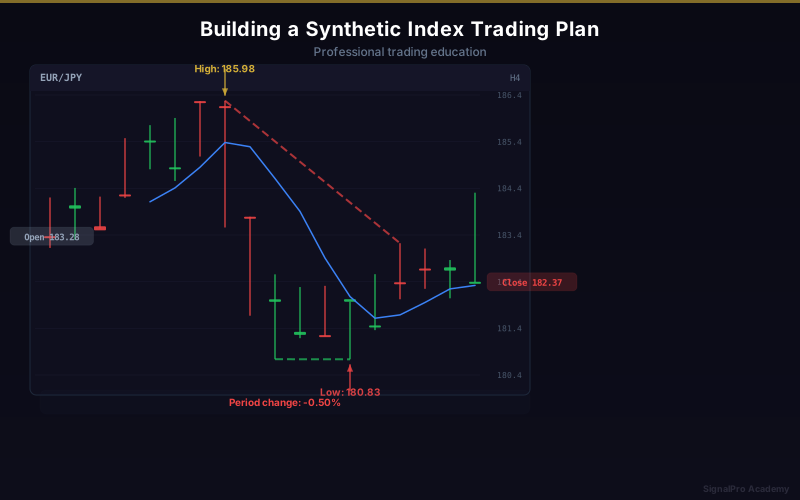
Building a Synthetic Index Trading Plan

A trading plan is the single most important document a trader can create. Without one, every trade is a gamble. With one, every trade is a calculated business decision. This lesson walks you through creating a complete trading plan tailored to synthetic indices.
Why You Need a Trading Plan
Without a Plan:
- Trade impulsively based on emotions
- Risk inconsistent amounts
- No clear entry/exit criteria
- No way to measure improvement
- Emotional decisions dominate
With a Plan:
- Every trade follows the same process
- Risk is controlled and consistent
- You know exactly when to enter and exit
- Performance is trackable and measurable
- Logic replaces emotion
Section 1: Trading Identity
Define who you are as a trader:
Questions to Answer:
- Available time: How many hours per day can you trade?
- Trading style: Scalper (minutes), Day trader (hours), Swing trader (days)?
- Risk tolerance: Conservative (0.5%), Moderate (1%), Aggressive (2%)?
- Capital: How much can you afford to lose entirely?
- Goals: Monthly return target? Learning milestone?
Example:
- I can trade 3 hours per day
- I am a day trader using M5 and M15 charts
- I risk 1% per trade (moderate)
- My trading capital is $500 (money I can afford to lose)
- My goal is to achieve 10% monthly return while maintaining <15% max drawdown
Section 2: Instrument Selection
Choose Your Primary Instruments:
Based on your style, select 1-3 synthetic indices:
| Style | Recommended Primary | Recommended Secondary |
|---|---|---|
| Scalping | V75, V100 | Crash/Boom 300 |
| Day Trading | V50, V75 | V25, Crash/Boom 500 |
| Swing Trading | V10, V25 | Step Index |
| Breakout Trading | Range Break 100 | Range Break 200 |
Rules:
- Master one instrument before adding another
- Do not trade more than 3 instruments simultaneously
- Track performance per instrument separately
Section 3: Strategy Rules
Entry Criteria (All Must Be Met):
- Trend Confirmation: Price above/below 200 EMA on H1
- Setup: 9 EMA crosses 21 EMA on M15 in trend direction
- Trigger: Price pulls back to 21 EMA and shows rejection candle on M5
- Confirmation: RSI is between 35-65 (not overbought/oversold)
Exit Criteria:
- Take Profit: 2x stop loss distance (2:1 risk/reward)
- Stop Loss: Below/above the last swing on M15
- Trailing Stop: Move SL to breakeven after 1:1 is reached
No-Trade Conditions:
- Do not trade within 30 minutes of starting a session (let the mind settle)
- Do not trade if you had 3 consecutive losses that day (daily limit)
- Do not trade if feeling angry, tired, or euphoric
- Do not trade if the instrument is in a tight, choppy range (no clear trend)
Section 4: Risk Management Framework
Per-Trade Risk:
- Maximum risk per trade: 1% of account balance
- Lot size calculated using the position sizing formula
- Stop loss is always set BEFORE entering the trade
Daily Limits:
- Maximum daily loss: 3% of account balance
- Maximum daily trades: 5 (prevents overtrading)
- After 3 consecutive losses: Stop trading for the day
Weekly Limits:
- Maximum weekly loss: 7% of account balance
- If hit, return to demo for the rest of the week
- Weekly review is mandatory (every Sunday)
Monthly Framework:
- Monthly drawdown limit: 15%
- If hit, take 1 full week off, then demo for 1 week
- Monthly strategy review and adjustment
Section 5: Trading Schedule
Example Schedule:
| Time | Activity |
|---|---|
| 8:00 AM | Review charts, mark key levels on H1 |
| 8:15 AM | Set alerts at key levels |
| 8:30 AM | Wait for setups (do not force trades) |
| 8:30-11:30 AM | Active trading session (3 hours) |
| 11:30 AM | Close all positions or set trailing stops |
| 11:45 AM | Journal review — record every trade |
| Evening | Update performance spreadsheet |
| Sunday | Weekly review — analyze statistics |
Section 6: Trading Journal
Record for Every Trade:
- Date and time
- Instrument (V75, Crash 300, etc.)
- Direction (Buy/Sell)
- Entry price
- Stop loss price
- Take profit price
- Lot size
- Risk amount ($)
- Result (Win/Loss/Breakeven)
- Profit/Loss ($)
- Screenshot (chart at time of entry and exit)
- Notes (what you did well, what you would change)
- Emotional state (calm, anxious, confident, rushed)
Weekly Review Questions:
- What was my win rate this week?
- What was my average risk/reward achieved?
- Which instrument performed best?
- Did I follow my plan on every trade?
- What was my biggest mistake? How do I fix it?
Section 7: Performance Targets
Progression Goals:
| Phase | Duration | Goal |
|---|---|---|
| Demo | 4 weeks | Follow the plan 100%, achieve 5% return |
| Micro Live | 4 weeks | Trade with 0.01 lots, follow the plan |
| Small Live | 8 weeks | Trade with calculated position sizes, 5% monthly |
| Full Live | Ongoing | Consistent 8-12% monthly with <15% drawdown |
When to Move to the Next Phase:
- You have followed your plan for 90%+ of all trades
- You have achieved the minimum return target
- You have NOT hit your maximum drawdown
- You feel confident and in control (not emotional)
Key Takeaways
- A trading plan removes emotion and creates consistency
- Cover all aspects: identity, instruments, strategy, risk, schedule, journal
- Follow the plan rigidly — adjust only during weekly reviews, never during live trading
- Progress through phases: demo to micro live to small live to full live
- The plan is a living document — update it monthly based on performance data
- A trader without a plan is just a gambler with a chart open