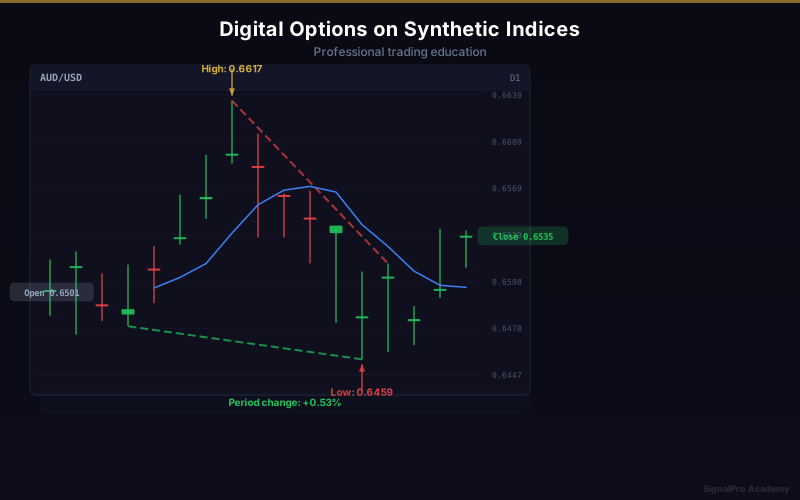
Digital Options on Synthetic Indices

Digital options (formerly binary options) are contracts that pay a fixed amount if a condition is met at expiry, or nothing if it is not. Deriv offers a wide range of digital option types on synthetic indices through Deriv Trader and SmartTrader.
Types of Digital Options
1. Rise/Fall (Up/Down)
The most basic option type:
- Rise: Pays out if the last tick is higher than the entry price
- Fall: Pays out if the last tick is lower than the entry price
- Duration: 1 tick to multiple hours
- Payout: Typically 85-95% of stake
- Best on: All Volatility Indices, Step Index
2. Higher/Lower
Predicting if price will be above or below a barrier:
- Higher: Pays out if exit price is above the barrier
- Lower: Pays out if exit price is below the barrier
- Barrier: Set above or below current price
- Payout: Varies based on barrier distance — farther = higher payout but lower probability
- Best on: Volatility Indices with clear trends
3. Touch/No Touch
Predicting if price will or will not reach a level:
- Touch: Pays out if price touches the barrier at any point during the contract
- No Touch: Pays out if price never touches the barrier
- Payout: Based on barrier distance and duration
- Best on: Low volatility indices (V10, V25) for No Touch; high volatility (V75, V100) for Touch
4. Ends Between/Ends Outside
Range-based options:
- Ends Between: Pays out if exit price is within the upper and lower barriers
- Ends Outside: Pays out if exit price is outside the barriers
- Best on: Ranging markets for Ends Between; volatile markets for Ends Outside
5. Digit Options (Unique to Synthetics)
Predicting the last digit of the price:
- Matches/Differs: Will the last digit match a specific number?
- Even/Odd: Will the last digit be even or odd?
- Over/Under: Will the last digit be over or under a number?
- Payout: Varies — Matches pays ~900% (1 in 10 chance), Even/Odd pays ~90% (1 in 2 chance)
- Duration: 1 tick only
- Best on: All Volatility Indices
Understanding Payouts
How Payouts Are Calculated:
- Payouts reflect the probability of the outcome
- Higher probability = lower payout
- Lower probability = higher payout
Example Payouts:
| Option Type | Probability | Typical Payout |
|---|---|---|
| Rise/Fall (1 tick) | ~50% | 85-95% |
| Even/Odd | 50% | ~90% |
| Matches (specific digit) | 10% | ~900% |
| Touch (close barrier) | ~70% | ~40% |
| Touch (far barrier) | ~20% | ~350% |
The House Edge:
- If Rise/Fall has a 50% chance but pays 90%, the expected value is: 0.5 x $1.90 + 0.5 x $0 = $0.95
- For every $1 risked, expected return is $0.95 — the house edge is 5%
- To profit long-term, you need to find edges through timing and strategy
Strategies for Digital Options
Strategy 1: Trend-Following Rise/Fall
- Identify the trend on a higher timeframe (H1 or H4)
- On M5, wait for a pullback in the trend direction
- Buy Rise in an uptrend or Fall in a downtrend
- Use 5-15 minute contracts for higher probability
Strategy 2: Digit Over/Under
- After a strong move in one direction, digits tend to cluster
- Look for digit patterns (many small or large digits in a row)
- Trade the opposite — if many high digits, trade "Under"
- Warning: This is based on perception, not actual predictive power
Strategy 3: No Touch During Low Volatility
- On V10 or V25 during calm periods
- Set barriers far from current price
- Trade No Touch with longer durations
- Collect payout if price stays within range
- Works best when the index is in a tight range
Risk Management for Digital Options
Golden Rules:
- Never stake more than 2-5% of your account per trade
- Fixed stake strategy: Use the same dollar amount for every trade
- Do not chase losses: Losing streaks happen — accept them
- Track your win rate: You need to win more than the breakeven rate
- Breakeven formula: Required win rate = 1 / (1 + payout rate)
Breakeven Win Rates:
| Payout | Breakeven Win Rate |
|---|---|
| 80% | 55.6% |
| 85% | 54.1% |
| 90% | 52.6% |
| 95% | 51.3% |
You need to consistently beat these rates to be profitable.
Key Takeaways
- Digital options offer defined risk — you know your maximum loss before entering
- Multiple option types let you express different market views
- Digit options are unique to synthetic indices and offer high payouts for low-probability events
- Focus on Rise/Fall and Higher/Lower as a beginner — they are the most straightforward
- The house edge means you need a genuine strategy to profit consistently
- Never risk more than a small percentage of your account per trade