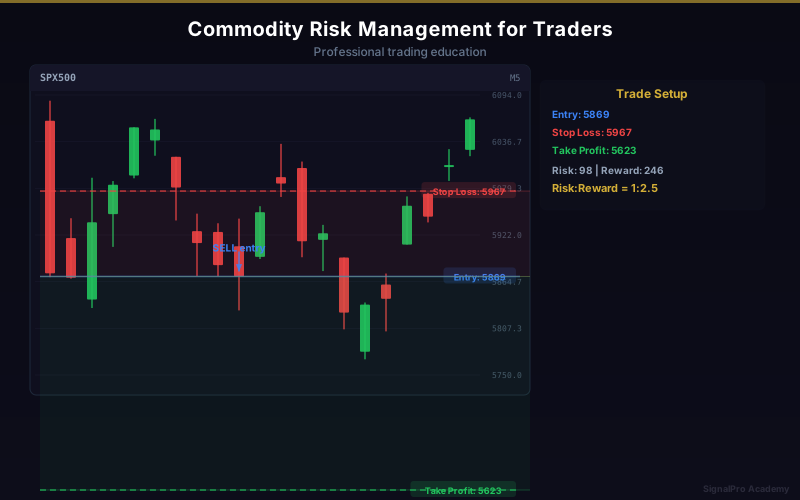
Commodity Risk Management for Traders
Commodity markets present unique risks that require specialized management techniques. The volatility and leverage involved demand disciplined risk control.
Unique Risks in Commodities
Leverage Risk
- Futures contracts require small margin relative to notional value
- A single crude oil contract controls $70,000+ of oil
- Initial margin may be only $5,000-8,000 (7-10% of notional)
- This magnifies both profits and losses enormously
Gap Risk
- Commodity markets close overnight (unlike forex)
- Weekend events can cause significant gaps
- OPEC decisions, weather events, geopolitical crises
- Your stop loss may not execute at your intended price
Limit Move Risk
- Some commodity exchanges have daily price limits
- "Lock limit" means no trading until the next session
- You cannot exit your position during a locked limit move
- Multiple consecutive limit moves can cause catastrophic losses
Roll Risk
- Futures contracts expire and must be rolled to the next month
- Rolling costs money in contango markets
- Liquidity decreases as expiration approaches
- First notice day can force physical delivery
Position Sizing for Commodities
The ATR Method
- Calculate Average True Range (ATR) for the commodity
- ATR measures typical daily price movement
- Set stops at 1.5-2x ATR from entry
- Size position so 2x ATR loss = 1-2% of account
Dollar Volatility Sizing
- Calculate the dollar value of average daily movement
- Example: Gold ATR = $20, contract = 100 oz, daily vol = $2,000
- If max risk is $2,000 per trade, you can trade 1 contract
- Adjust for each commodity's specific volatility
Correlation Adjustment
- Many commodities are correlated (oil and gas, grains together)
- If you hold 3 correlated positions, your real risk is 3x
- Treat correlated positions as a single risk block
- Reduce individual position sizes when holding multiple correlated trades
Stop Loss Strategies
Volatility-Based Stops
- Use ATR multiples rather than fixed dollar amounts
- Wide enough to avoid noise, tight enough to protect capital
- Adjust stop width for each commodity's volatility profile
Time-Based Stops
- If a trade has not moved in your direction within X days, exit
- Especially useful for seasonal and event-driven trades
- Opportunity cost of capital sitting in a stagnant trade
Structural Stops
- Place stops beyond significant technical levels
- Below support for longs, above resistance for shorts
- If the level breaks, your thesis is invalidated
Portfolio-Level Risk
Maximum Portfolio Heat
- Never risk more than 6% of total account at any one time
- With 2% risk per trade, this means a maximum of 3 open positions
- Reduce this during high-volatility environments
- Close your weakest position before adding a new one
Diversification Rules
- No more than 40% of risk in a single sector (energy, metals, agriculture)
- Include both long and short positions when possible
- Mix timeframes (some short-term, some longer-term)
- Avoid concentration in a single commodity
Key Takeaways
- Commodity leverage demands smaller position sizes than other markets
- Gap risk and limit moves require conservative overnight exposure
- Size positions based on commodity-specific volatility (ATR)
- Account for correlations between commodity positions
- Portfolio-level risk limits prevent catastrophic drawdowns
Lesson Discussion