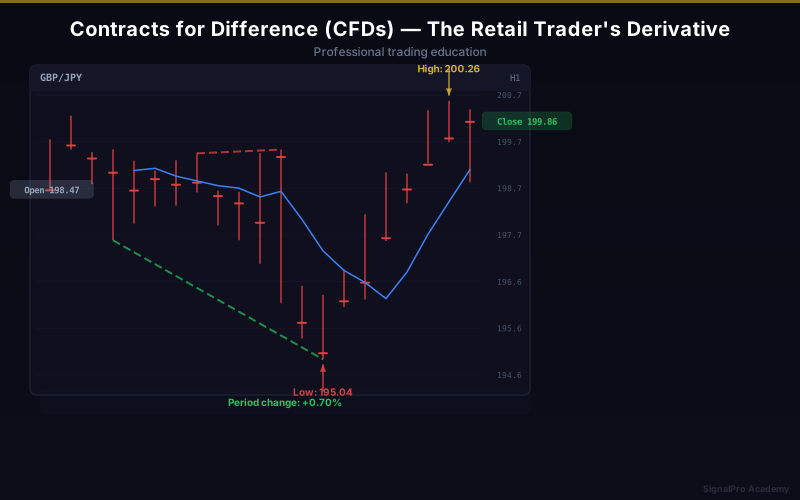
Contracts for Difference (CFDs)
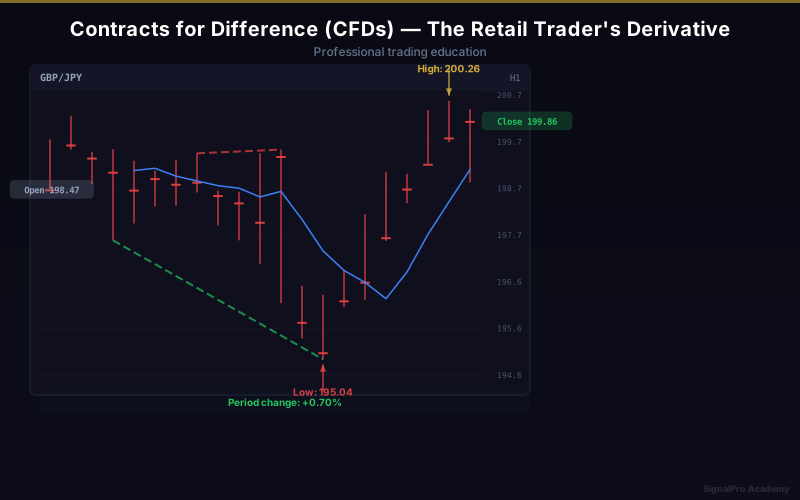
Contracts for Difference (CFDs) are the most widely used derivative instrument among retail traders. A CFD is an agreement between a trader and a broker to exchange the difference in price of an asset from the time the contract is opened to when it is closed. You never own the underlying asset — you simply profit or lose from price movements.
How CFDs Work
The Mechanics:
- You open a CFD position (buy or sell) on an asset
- The broker mirrors the asset's price movements in your account
- If price moves in your favor: profit is credited
- If price moves against you: loss is debited
- You close the position at any time — no expiration date
Example — Buying a Gold CFD:
- Gold price: $2,000/oz
- You BUY 1 lot of Gold CFD (equivalent to 100 oz)
- Margin required: $2,000 (1% margin = 100:1 leverage)
- Gold rises to $2,050: Profit = $50 x 100 = $5,000
- Gold falls to $1,950: Loss = $50 x 100 = $5,000
- At no point did you own physical gold
Example — Selling a Stock CFD:
- Tesla price: $200
- You SELL 100 shares as a CFD (short position)
- Margin required: $4,000 (20% margin = 5:1 leverage)
- Tesla drops to $180: Profit = $20 x 100 = $2,000
- Tesla rises to $220: Loss = $20 x 100 = $2,000
- You never borrowed actual Tesla shares
CFD Leverage and Margin
How Leverage Works:
Leverage allows you to control a large position with a small deposit. The margin is your deposit.
| Leverage | Margin Required | Position Control |
|---|---|---|
| 1:5 | 20% | $1,000 controls $5,000 |
| 1:10 | 10% | $1,000 controls $10,000 |
| 1:30 | 3.33% | $1,000 controls $30,000 |
| 1:100 | 1% | $1,000 controls $100,000 |
| 1:500 | 0.2% | $1,000 controls $500,000 |
Regulatory Leverage Limits:
| Region | Max Leverage (Forex) | Max Leverage (Stocks) |
|---|---|---|
| EU (ESMA) | 1:30 | 1:5 |
| UK (FCA) | 1:30 | 1:5 |
| Australia (ASIC) | 1:30 | 1:5 |
| USA | CFDs not allowed | N/A |
| Offshore brokers | 1:500+ | 1:20+ |
Margin Call and Stop Out:
- Margin level = (Equity / Used Margin) x 100%
- Margin call: Typically at 100% margin level — warning to add funds
- Stop out: Typically at 50% margin level — positions automatically closed
- Example: $1,000 equity, $500 used margin = 200% margin level (safe)
- If equity drops to $500: Margin level = 100% (margin call)
- If equity drops to $250: Margin level = 50% (stop out — positions closed)
Costs of CFD Trading
1. Spread:
The difference between the buy (ask) and sell (bid) price. This is the broker's primary revenue.
- EUR/USD: Typically 0.5-2.0 pips
- Gold: Typically 20-50 cents/oz
- Tesla: Typically $0.10-$0.50
2. Commission:
Some brokers charge a per-trade commission instead of or in addition to the spread.
- ECN accounts: Raw spread + $3-7 per lot commission
- Standard accounts: Wider spread, no commission
3. Overnight Financing (Swap):
Holding a CFD position overnight incurs a financing charge:
- Long positions: You pay interest (you are effectively borrowing money)
- Short positions: You may receive or pay interest (depends on rates)
- Swap rate: Based on interbank rates + broker markup
- Swap-free accounts: Available for Islamic finance (Sharia compliance)
4. Currency Conversion:
If your account is in USD but you trade EUR/GBP, the broker converts your P&L at a fee.
What Can You Trade with CFDs?
Asset Classes Available:
- Forex: All major, minor, and exotic pairs (EUR/USD, GBP/JPY, USD/ZAR)
- Stocks: Individual companies (Apple, Tesla, Amazon, etc.)
- Indices: S&P 500, NASDAQ, DAX, FTSE 100, Nikkei 225
- Commodities: Gold, silver, oil, natural gas, wheat, coffee
- Cryptocurrencies: Bitcoin, Ethereum, Litecoin, Ripple
- ETFs: Some brokers offer CFDs on popular ETFs
- Bonds: Government bond CFDs
CFDs vs Other Instruments
| Feature | CFDs | Futures | Stocks | Options |
|---|---|---|---|---|
| Ownership | No | No | Yes | No |
| Leverage | High | High | Low/None | Built-in |
| Expiration | No | Yes | No | Yes |
| Short selling | Easy | Easy | Complex | Easy (puts) |
| Min capital | $50+ | $5,000+ | Varies | Varies |
| Exchange | OTC | Exchange | Exchange | Both |
| Regulation | Varies | Strict | Strict | Strict |
| Available in US | No | Yes | Yes | Yes |
Advantages of CFDs
- Access to multiple markets from one account
- Low capital requirements — start with small deposits
- Easy short selling — profit from falling prices naturally
- No expiration — hold positions as long as you want
- Fractional trading — trade micro lots (0.01 lots)
- Leverage — amplify returns on limited capital
Risks of CFDs
- Leverage amplifies losses as well as profits
- Overnight costs erode profits on long-term positions
- Counterparty risk — your broker is the other side of the trade
- Regulatory gaps — offshore brokers may offer less protection
- Overtrading temptation — easy access leads to excessive trading
- Not available in some countries (US, Belgium, etc.)
Key Takeaways
- CFDs let you trade price movements without owning the underlying asset
- Leverage is powerful but dangerous — it amplifies both gains and losses
- Understand all costs: spread, commission, overnight financing
- CFDs are not available in all countries — check your jurisdiction
- Choose regulated brokers (FCA, ASIC, CySEC) for maximum protection
- CFDs are the foundation of retail forex, index, and commodity trading