What Are Financial Derivatives?

A derivative is a financial contract whose value is derived from the performance of an underlying asset, index, or rate. Derivatives are among the most important instruments in modern finance, used for hedging risk, speculating on price movements, and gaining exposure to assets without owning them directly.
The Core Concept
Definition:
A derivative does not have intrinsic value of its own. Its price is derived from something else — the "underlying asset." This underlying can be:
- A stock (Apple, Tesla, Amazon)
- A currency pair (EUR/USD, GBP/JPY)
- A commodity (gold, oil, wheat)
- An interest rate (LIBOR, SOFR)
- An index (S&P 500, NASDAQ, FTSE 100)
- A cryptocurrency (Bitcoin, Ethereum)
- Even another derivative (options on futures)
Simple Example:
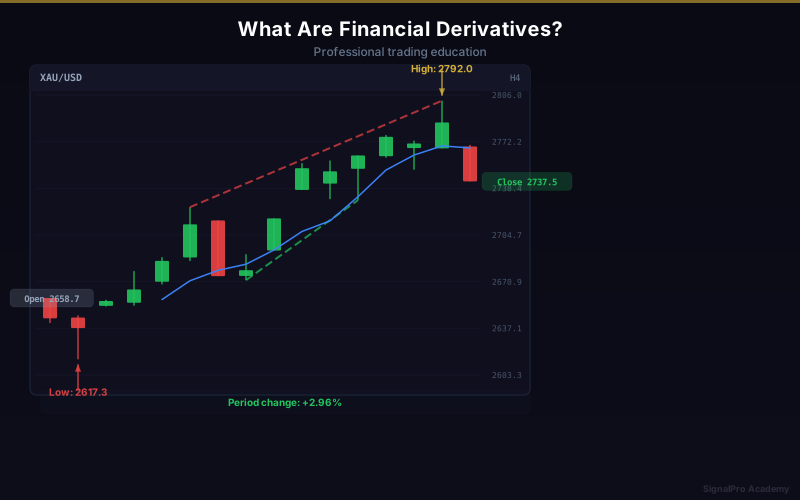
Imagine gold is trading at $2,000/oz. A gold futures contract is a derivative because its value goes up and down based on the price of gold. You do not own the gold — you own a contract that references gold's price.
Why Derivatives Exist
1. Hedging (Risk Reduction)
The original purpose of derivatives. A farmer growing wheat can sell wheat futures to lock in a price today, protecting against a price drop at harvest time. An airline can buy oil futures to protect against rising fuel costs.
2. Speculation
Traders use derivatives to bet on price direction without owning the underlying asset. This requires less capital than buying the asset directly and offers leverage.
3. Price Discovery
Derivative markets help determine the fair price of assets by aggregating the views of thousands of participants.
4. Access and Efficiency
Derivatives provide access to markets that might otherwise be difficult to trade. You can gain exposure to the S&P 500 with a single futures contract instead of buying 500 individual stocks.
The Major Types of Derivatives
1. Futures Contracts
- What: Obligation to buy or sell an asset at a set price on a future date
- Traded on: Exchanges (CME, ICE, Eurex)
- Standardized: Yes — contract sizes, expiration dates are fixed
- Settlement: Physical delivery or cash settlement
- Example: 1 Gold Futures = 100 oz of gold
2. Options Contracts
- What: Right (not obligation) to buy (call) or sell (put) at a set price
- Traded on: Exchanges and OTC
- Premium: Buyer pays a premium for the option
- Example: A call option on Apple at $150 strike, expiring in 30 days
3. Forwards
- What: Similar to futures but private, customized, and traded OTC
- Counterparty risk: Higher than exchange-traded futures
- Used by: Banks, corporations for hedging specific exposures
- Example: A company locks in an exchange rate for a payment due in 90 days
4. Swaps
- What: Agreement to exchange cash flows between two parties
- Types: Interest rate swaps, currency swaps, commodity swaps
- Used by: Banks, corporations, institutional investors
- Example: Company A pays fixed interest, Company B pays floating interest
5. Contracts for Difference (CFDs)
- What: Agreement to exchange the difference in price from open to close
- No ownership: You never own the underlying asset
- Leverage: Typically high (1:30 to 1:500)
- Used by: Retail traders, widely available through online brokers
- Example: Buying a CFD on EUR/USD to speculate on the euro strengthening
Derivatives Market Size
The global derivatives market is enormous:
- Notional value: Over $600 trillion (larger than global GDP)
- Daily trading volume: Trillions of dollars across all exchanges
- Participants: Banks, hedge funds, pension funds, corporations, retail traders
- Growth: Continuously expanding as new products are created
Derivatives vs Cash Markets
| Feature | Cash/Spot Market | Derivatives Market |
|---|---|---|
| Ownership | You own the asset | You own a contract |
| Capital required | Full price | Margin/premium only |
| Leverage | None or limited | Significant leverage |
| Expiration | No expiry | Most have expiry dates |
| Short selling | Complex/restricted | Easy and natural |
| Complexity | Simple | Can be complex |
| Regulation | Standard | Additional oversight |
Risks of Derivatives
1. Leverage Risk
Derivatives amplify both profits AND losses. A 10:1 leverage means a 10% move against you wipes out your entire position.
2. Counterparty Risk
In OTC derivatives (forwards, swaps), the other party might default. Exchange-traded derivatives (futures, listed options) reduce this through clearinghouses.
3. Complexity Risk
Some derivatives (exotic options, structured products) are extremely complex. Trading instruments you do not fully understand is dangerous.
4. Liquidity Risk
Not all derivatives have active markets. Illiquid derivatives may be difficult to exit at fair prices.
5. Market Risk
The underlying asset can move against your position rapidly, especially with leverage.
Key Takeaways
- Derivatives are contracts whose value comes from an underlying asset
- The four main types are futures, options, forwards, and swaps — plus CFDs for retail traders
- They serve three primary purposes: hedging, speculation, and price discovery
- Leverage is both the greatest advantage and the greatest danger of derivatives
- Understanding derivatives is essential for any serious trader or investor
- Always fully understand a derivative product before trading it