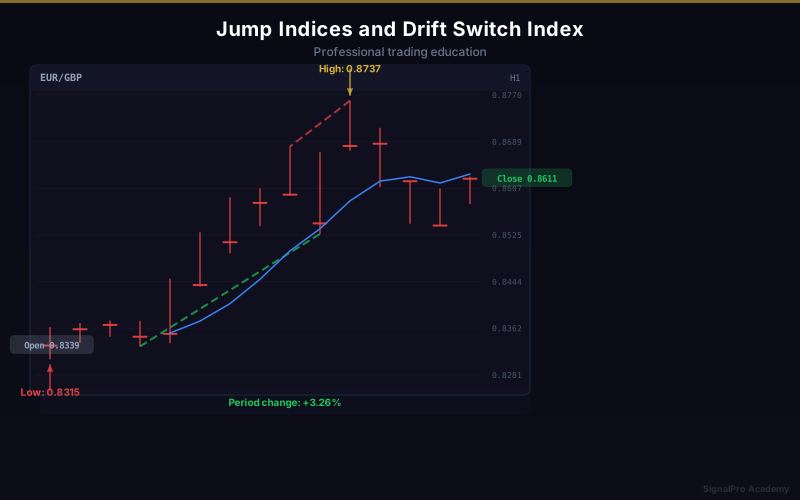
Jump Indices and Drift Switch Index

Jump Indices and the Drift Switch Index represent advanced synthetic instruments with unique behaviors not found in traditional markets. Understanding these instruments expands your trading toolkit and prepares you for more complex trading scenarios.
Jump Indices
What Are Jump Indices?
Jump Indices simulate markets that experience sudden price jumps (gaps) at specific average frequencies. Unlike Crash/Boom indices where spikes are directional, Jump Index jumps can occur in either direction.
Available Jump Indices:
- Jump 10: Jumps on average every 10 minutes — very frequent
- Jump 25: Jumps on average every 25 minutes
- Jump 50: Jumps on average every 50 minutes
- Jump 75: Jumps on average every 75 minutes
- Jump 100: Jumps on average every 100 minutes — least frequent
How Jumps Work:
- Price moves normally between jumps (similar to a Volatility Index)
- At random intervals (averaging the specified frequency), a sudden gap occurs
- The jump can be in either direction (up or down)
- Jump sizes vary — some are small, others are significant
- After a jump, normal price action resumes
Trading Jump Indices:
- Between jumps: Trade normally using technical analysis
- Managing jump risk: Use wider stop losses to survive small jumps
- Position sizing: Reduce lot sizes since jumps can gap past stop losses
- Strategy: Focus on the normal price movement and treat jumps as random events to manage
Jump Index Selection:
| Index | Jump Frequency | Volatility Between Jumps | Best For |
|---|---|---|---|
| Jump 10 | Very high | Moderate | Scalpers comfortable with gaps |
| Jump 25 | High | Moderate | Active day traders |
| Jump 50 | Medium | Moderate | Balanced approach |
| Jump 75 | Low-medium | Moderate | Patient traders |
| Jump 100 | Low | Moderate | Swing-style trading |
Drift Switch Index
What Is the Drift Switch Index?
The Drift Switch Index is a unique synthetic that alternates between bullish (upward drift) and bearish (downward drift) trends at random intervals. It simulates a market that periodically changes its directional bias.
How It Works:
- The index enters a bullish phase — price drifts upward with normal fluctuations
- At a random point, it switches to a bearish phase — price drifts downward
- The switch timing is unpredictable
- The duration of each phase varies
- The transition between phases can be gradual or sudden
Trading the Drift Switch Index:
- Trend identification: Use moving averages to determine current drift direction
- Trade with the drift: Buy during bullish phases, sell during bearish phases
- Switch detection: Watch for early signs of a drift switch (MA crossover, momentum change)
- Quick exits: When you detect a switch, exit your position promptly
Indicators That Help:
- 50 EMA + 200 EMA crossover: Identifies the current drift direction
- RSI: Shows when momentum is shifting
- MACD: Detects early trend changes
- ADX: Measures trend strength — weakening ADX may signal an upcoming switch
Risk Management:
- Use trailing stops to lock in profits during a drift phase
- Keep stops tight enough that a drift switch does not erase your gains
- Avoid adding to positions late in a drift — the switch could be imminent
- Risk no more than 1% per trade
Key Takeaways
- Jump Indices add gap risk to normal price movement — adjust stop losses accordingly
- Lower frequency Jump Indices (75, 100) have fewer but potentially larger jumps
- The Drift Switch Index alternates between bullish and bearish trends randomly
- Trade with the current drift direction and exit quickly when a switch is detected
- Both instrument types require disciplined risk management due to their unpredictable elements