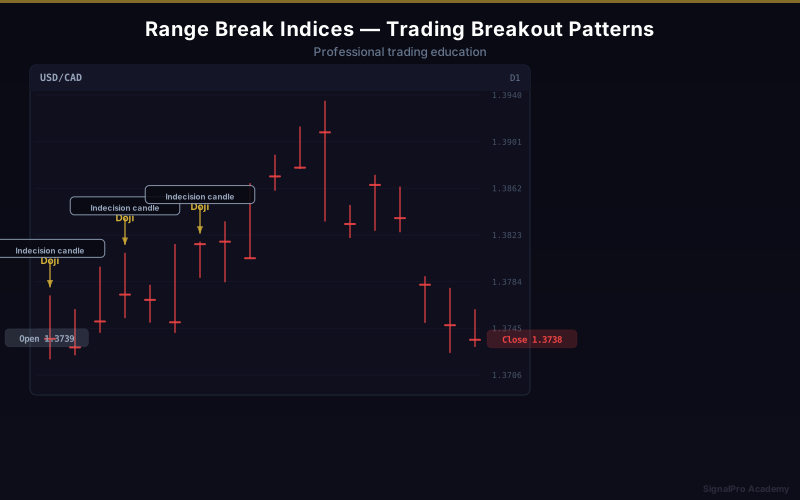
Range Break Indices
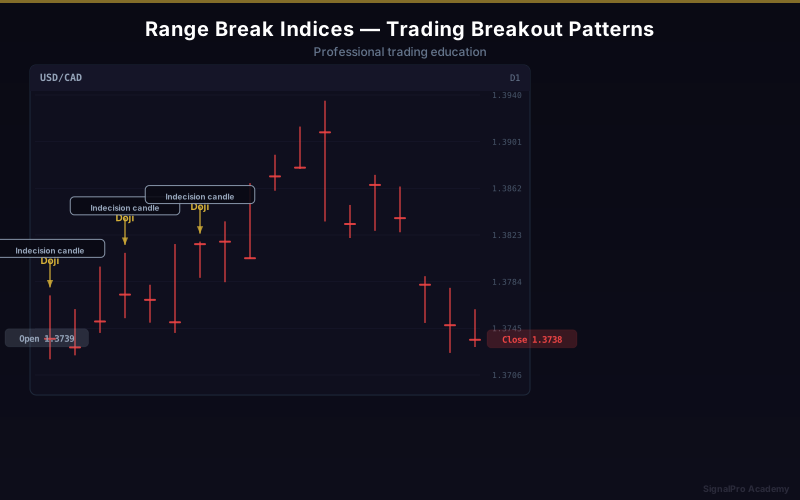
Range Break indices are synthetic instruments that simulate one of the most common market behaviors: price trading within a range (consolidation) followed by a breakout. They are designed to help traders practice breakout strategies without the unpredictability of real markets.
Available Range Break Indices
Range Break 100
- Price trades within a defined range
- Breaks out of the range on average every 100 ticks
- After a breakout, a new range forms
- More frequent breakouts, smaller ranges
Range Break 200
- Price trades within a defined range
- Breaks out of the range on average every 200 ticks
- After a breakout, a new range forms
- Less frequent breakouts, potentially larger moves
How Range Break Indices Work
The Range Phase:
- Price establishes an upper boundary (resistance) and lower boundary (support)
- Price oscillates between these boundaries
- The range width varies but remains within defined parameters
- During this phase, price movement is contained and predictable
The Breakout Phase:
- Price breaks decisively above resistance or below support
- The breakout direction is random (up or down)
- After the breakout, price moves impulsively in the breakout direction
- A new range eventually forms at the new price level
Trading Strategies
Strategy 1: Breakout Trading
The primary strategy:
- Identify the range boundaries on the chart
- Place pending orders above resistance (buy stop) and below support (sell stop)
- When one triggers, cancel the other
- Ride the breakout move until a new range forms
- Set stop loss just inside the old range
Strategy 2: Range Trading
Trading within the range:
- Buy at support, sell at resistance
- Use tight stop losses just beyond the range
- Take profit at the opposite boundary
- Risk: A breakout will stop you out — accept this as a cost of the strategy
Strategy 3: Breakout Retest
Wait for confirmation:
- Wait for price to break out of the range
- Wait for price to pull back and retest the broken level
- Enter in the direction of the breakout on the retest
- Stop loss below the retest level
Comparing Range Break 100 vs 200
| Feature | Range Break 100 | Range Break 200 |
|---|---|---|
| Breakout frequency | More frequent | Less frequent |
| Range duration | Shorter | Longer |
| Range width | Typically narrower | Typically wider |
| Breakout magnitude | Generally smaller | Generally larger |
| Best for | Active traders, scalpers | Patient traders, swing approach |
Risk Management
- Range trading risk: Stop loss beyond the range boundary — expect to be stopped out on breakouts
- Breakout trading risk: False breakouts can occur — always use stop losses
- Position sizing: Risk 1-2% maximum per trade
- Do not chase: If you miss a breakout, wait for the next range to form
Key Takeaways
- Range Break indices alternate between consolidation (range) and expansion (breakout)
- They are the ideal training ground for breakout strategies
- Range Break 100 has more frequent but potentially smaller breakouts
- Combine range trading during consolidation with breakout trading for maximum opportunity
- Always have a stop loss in place — breakouts can happen at any time