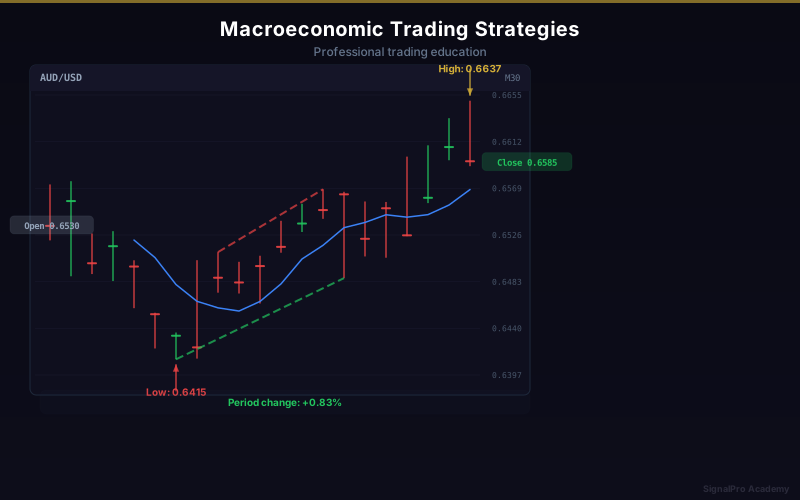
Macroeconomic Trading Strategies
Macro trading uses economic data and global trends to make trading decisions across multiple asset classes simultaneously. This is how institutional traders and hedge funds operate.
The Macro Approach
What is Macro Trading?
- Trading based on economic trends and policy decisions
- Positions across multiple asset classes (forex, bonds, stocks, commodities)
- Top-down analysis (global economy to individual trades)
- Longer holding periods (weeks to months)
- Used by hedge funds like Bridgewater, Soros Fund, Tudor
vs. Technical Trading
- Technical: Charts and patterns, any timeframe
- Macro: Economic data and flows, longer timeframe
- Best approach: Combine both (macro for direction, technical for entry)
Core Macro Trading Strategies
1. The Rate Cycle Trade
- Identify where each major economy is in the rate cycle
- Buy currencies with rising/higher rates
- Sell currencies with falling/lower rates
- Position in rate-sensitive assets accordingly
- Fed hiking rates: Buy USD, sell EUR or JPY
- Fed cutting rates: Sell USD, buy gold, buy long-duration bonds
- Divergent policies (Fed hiking, ECB holding): Trade the divergence
2. The Risk-On / Risk-Off Framework
- Risk-On (optimism): Buy equities, commodity currencies (AUD, NZD), sell safe havens
- Risk-Off (fear): Buy USD, JPY, CHF, gold, Treasuries; sell equities, EM
- Indicators: VIX (fear gauge), credit spreads, equity momentum
- Long: AUD/JPY, S&P 500, copper, EM equities
- Short: Gold, TLT (long-term Treasuries)
- Long: USD/JPY bearish (JPY strength), gold, TLT
- Short: AUD/JPY, S&P 500, emerging market currencies
3. The Inflation Trade
- Rising inflation: Buy commodities, gold, TIPS, real assets
- Falling inflation: Buy bonds, growth stocks, defensive assets
- Watch: CPI trends, commodity prices, wage growth, money supply
4. The Growth Divergence Trade
- Compare growth rates between major economies
- Buy assets in stronger-growth economies
- Sell assets in weaker-growth economies
- Use PMI data for real-time growth comparison
- US PMI: 55 (strong), Eurozone PMI: 47 (weak)
- Trade: Long USD/EUR (short EUR/USD)
- Also: Overweight US stocks, underweight European stocks
5. The Carry Trade
- Borrow in low-yield currency
- Invest in high-yield currency
- Earn the interest rate differential daily
- Works best in low-volatility environments
- Unwind when volatility spikes
Building Your Macro Dashboard
Essential Data (Check Weekly)
- PMI data (US, Eurozone, China, UK)
- Yield curve shape (2Y-10Y spread)
- VIX level and trend
- DXY (Dollar Index) direction
- Credit spreads (investment-grade and high-yield)
- Central bank rhetoric and next meeting dates
Monthly Data Review
- CPI/PCE inflation trends
- NFP and employment trends
- GDP growth comparisons
- Current account balances
- Central bank balance sheet changes
Position Management
Multi-Asset Portfolio
- Do not put all risk in one trade
- Spread macro views across correlated positions
- Example: Bullish USD view expressed through USD/JPY + short gold + short EUR/USD
- If one leg stops out, others may still profit
Time Horizon
- Macro themes develop over weeks and months
- Do not expect overnight results
- Add to winners gradually
- Cut losers quickly if the thesis is invalidated
Thesis Invalidation
- Define what would prove your macro thesis wrong
- If contradicting data emerges, reassess immediately
- Being wrong is normal - staying wrong is the problem
- Document your thesis and review weekly
Key Takeaways
- Macro trading combines economic analysis with multi-asset positioning
- The rate cycle trade is the most fundamental macro strategy
- Risk-on/risk-off framework helps structure portfolio tilts
- PMI data provides the fastest real-time view of economic direction
- Express macro views across multiple correlated positions for diversification
Lesson Discussion