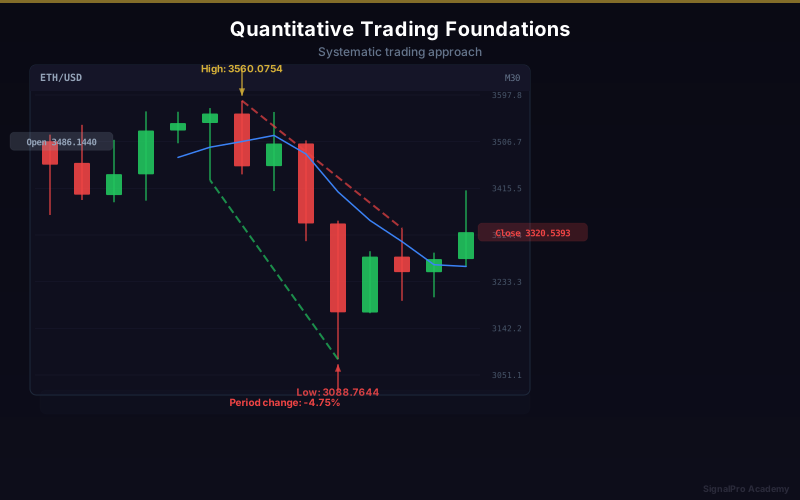
Quantitative Trading Foundations
Quantitative trading uses mathematical models and statistical analysis to identify trading opportunities.
What is Quantitative Trading?
Definition
- Data-driven decision making
- Statistical edge validation
- Systematic approach
- Removes emotional bias
Statistical Concepts
Probability and Expected Value
- Every trade is a probability
- Expected Value = Sum of (Outcome x Probability)
- Positive EV = profitable over time
- Individual outcomes are random
Standard Deviation
- Measures volatility/dispersion
- 68% within 1 SD, 95% within 2 SD
- Used for position sizing
- Risk quantification
Correlation and Covariance
- How variables move together
- Portfolio risk depends on correlation
- Diversification benefits
- Regime changes alter correlations
Backtesting Properly
Avoiding Curve Fitting
- Out-of-sample testing required
- Simple rules over complex
- Large sample sizes (500+ trades)
- Test across market regimes
Walk-Forward Analysis
- Optimize on period 1
- Test on period 2
- Re-optimize, test on period 3
- Most realistic performance estimate
Key Metrics
- Sharpe Ratio (risk-adjusted return)
- Maximum Drawdown
- Calmar Ratio (return/max DD)
- Win Rate and Profit Factor
Building a Trading Model
Step 1: Hypothesis
- What market behavior are you exploiting?
- Why does this edge exist?
- Is it likely to persist?
Step 2: Define Rules
- Clear entry/exit criteria
- No discretion
- Can be programmed
Step 3: Backtest
- Historical data testing
- Multiple timeframes
- Various market conditions
Step 4: Validate
- Out-of-sample testing
- Paper trading
- Small live testing
Step 5: Deploy and Monitor
- Full implementation
- Ongoing performance tracking
- Regime monitoring
Lesson Discussion