Step Index
The Step Index is the simplest and most beginner-friendly synthetic index available on Deriv. It moves in fixed price steps — each tick, the price either goes up by 0.1 or down by 0.1, with an equal 50/50 probability. This makes it the purest form of a random walk instrument.
How the Step Index Works
Mechanics:
- Every tick, the price moves exactly 0.1 in one direction
- There is a 50% chance of moving up and 50% chance of moving down
- Each tick is completely independent of the previous tick
- There are no trends, no momentum, and no mean reversion built in
Visual Behavior:
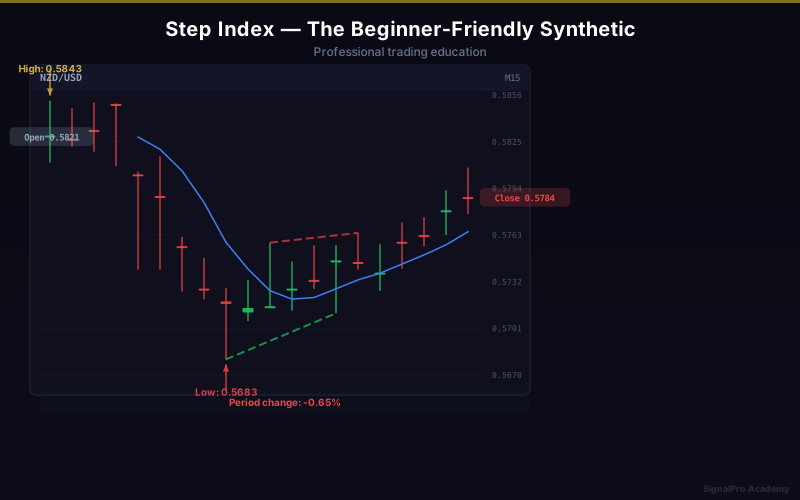
- On a chart, the Step Index looks like a random staircase
- Short-term, it appears choppy and directionless
- Over longer periods, random clusters may look like "trends" (but they are not predictable)
Why Trade the Step Index?
Educational Value:
- Teaches randomness — Understanding that markets can move randomly helps you appreciate when real markets have actual trends
- Risk management practice — Perfect for practicing stop losses and position sizing without complex analysis
- Equal probability — Forces you to rely on risk/reward rather than win rate
- Simple math — Each pip is worth a fixed amount, making profit/loss calculations easy
Practical Uses:
- Scalping practice — Quick entries and exits in a controlled environment
- Strategy testing — Test if a strategy relies on trend or can work in random conditions
- Weekend trading — Available 24/7 when forex markets are closed
Trading Strategies for Step Index
Strategy 1: Fixed Risk/Reward
Since the probability is always 50/50:
- Set a take profit that is larger than your stop loss
- Example: Stop loss of 5 steps, take profit of 10 steps
- You win 50% of the time but earn twice as much when you win
- Expected outcome: Profitable over many trades (positive expectancy)
Strategy 2: Streak Trading
Looking for clusters of moves in one direction:
- Count consecutive up or down moves
- After a long streak, consider a reversal trade
- Caution: Each tick is independent — streaks do not predict future moves
- This strategy is based on probability, not certainty
Strategy 3: Digital Options
The Step Index is excellent for digital options trading:
- Rise/Fall contracts: 50/50 probability
- Higher/Lower contracts: Set strike prices
- Key: Focus on payout rates — if payout exceeds 2:1, the trade has positive expectancy regardless of direction
Lot Sizes and Pip Values
| Lot Size | Pip Value | Risk per 10-step move |
|---|---|---|
| 0.01 | $0.01 | $0.10 |
| 0.10 | $0.10 | $1.00 |
| 0.50 | $0.50 | $5.00 |
| 1.00 | $1.00 | $10.00 |
Risk Management
Rules:
- Decide your maximum loss before entering — The fixed step size makes this easy
- Use proper position sizing — Risk no more than 2% of your account per trade
- Set both stop loss and take profit — Never leave a Step Index trade open without limits
- Keep a trading journal — Track your results to verify your strategy works over many trades
Common Misconceptions
- "The Step Index trends" — It does not. Any apparent trend is random clustering
- "After many up moves, it must go down" — This is the gambler's fallacy. Each tick is independent
- "Technical analysis works here" — Traditional TA has limited value on a pure random walk
- "You can predict the next move" — Nobody can. The outcome is genuinely random
Key Takeaways
- The Step Index is the simplest synthetic: 50/50 probability, fixed 0.1 step size
- It is ideal for learning risk management and understanding randomness
- Focus on risk/reward ratios rather than trying to predict direction
- Perfect for beginners who want a low-stress introduction to synthetic trading
- Use it to practice discipline, position sizing, and trading psychology