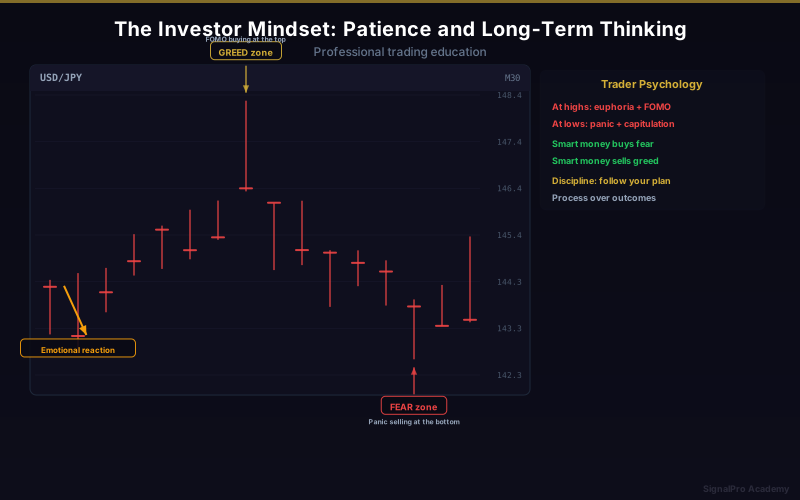
The Investor Mindset: Patience and Long-Term Thinking
The difference between successful long-term investors and everyone else is not intelligence or secret knowledge. It is temperament, patience, and the ability to think in decades rather than days.
The Behavior Gap
What the Research Shows
- The S&P 500 has returned approximately 10% annually over the past century
- The average investor earns approximately 6% (DALBAR studies)
- The 4% gap is entirely due to behavioral mistakes
- Buying during euphoria and selling during panic
- This behavior gap costs the average investor hundreds of thousands over a lifetime
Why We Make Bad Decisions
- Our brains are wired for survival, not investing
- We feel losses 2.5x more intensely than equivalent gains
- We extrapolate recent events into the future (recency bias)
- We follow the crowd for safety (herd mentality)
- Short-term noise triggers fight-or-flight responses
Developing the Investor Mindset
Think in Decades
- Your investing horizon is likely 30-50 years
- In any given year, stocks can drop 30-50%
- Over any 20-year period, stocks have never lost money (S&P 500)
- The market will crash. This is normal and expected.
- Crashes are temporary. Your investment horizon is permanent.
Embrace Volatility as Opportunity
- Market drops are sales events for long-term investors
- The best returns come from buying when everyone is fearful
- Regular investing through downturns (DCA) captures the bargains
- Volatility is the price you pay for long-term stock market returns
Focus on What You Can Control
- Can control: Savings rate, asset allocation, costs, behavior
- Cannot control: Market returns, inflation, government policy, geopolitics
- Spend 100% of your energy on what you can control
- Accept uncertainty about everything else
Common Psychological Traps
FOMO (Fear of Missing Out)
- Seeing others get rich on meme stocks, crypto, or hot trends
- Abandoning your plan to chase performance
- Cure: Remember that for every visible winner, many more lose
- Stick to your boring, proven strategy
Analysis Paralysis
- Waiting for the "perfect" time to invest
- There is never a perfect time. The best time was yesterday.
- The second best time is today
- DCA removes the timing decision entirely
Overconfidence After Success
- A few winning trades make you feel like an expert
- You increase risk, concentrate positions, or abandon diversification
- A bull market makes everyone look like a genius
- Stay humble and disciplined regardless of results
Panic Selling During Drops
- The most destructive behavior for long-term investors
- If you sell during a 30% drop, you crystallize the loss
- You then need to decide WHEN to get back in (you usually do not)
- Missing the recovery is often worse than experiencing the drop
Building Resilience
Create Automatic Systems
- Automate contributions to investment accounts
- Set it and forget it removes emotional decision-making
- Automation makes good behavior the default
Have an Investment Policy Statement
- Write down your strategy, allocation, and rules
- Include what you will do during market drops
- Refer to it during emotional moments
- Update it annually, not reactively
Learn Financial History
- Every crash has been followed by recovery and new highs
- 1929, 1987, 2000, 2008, 2020 - all recovered
- The market's long-term trajectory is upward
- Historical context provides perspective during difficult times
Key Takeaways
- Behavior, not intelligence, is the primary determinant of investment success
- Think in decades, not days or months
- Market crashes are normal, expected, and temporary
- Automate your investing to remove emotional decision-making
- The best investors are boring investors who stick to their plan
Lesson Discussion