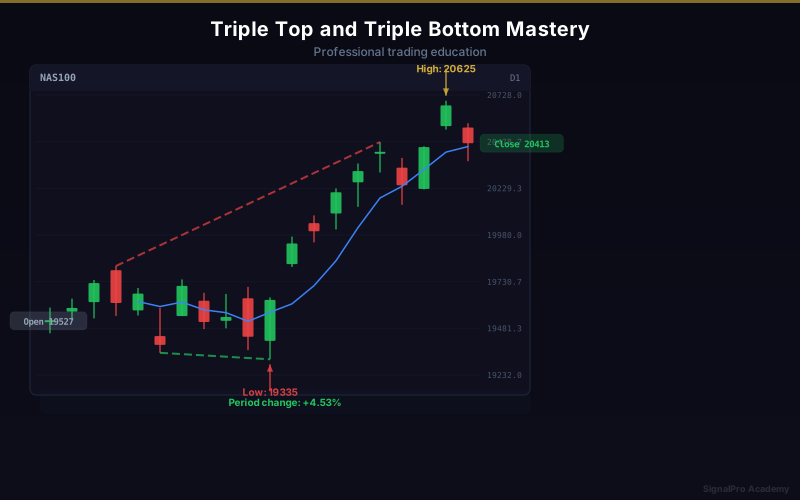
Triple Top and Triple Bottom Mastery
Triple tops and bottoms are among the most reliable reversal patterns because price tests a level three times and fails, confirming strong supply or demand.
Triple Top Pattern
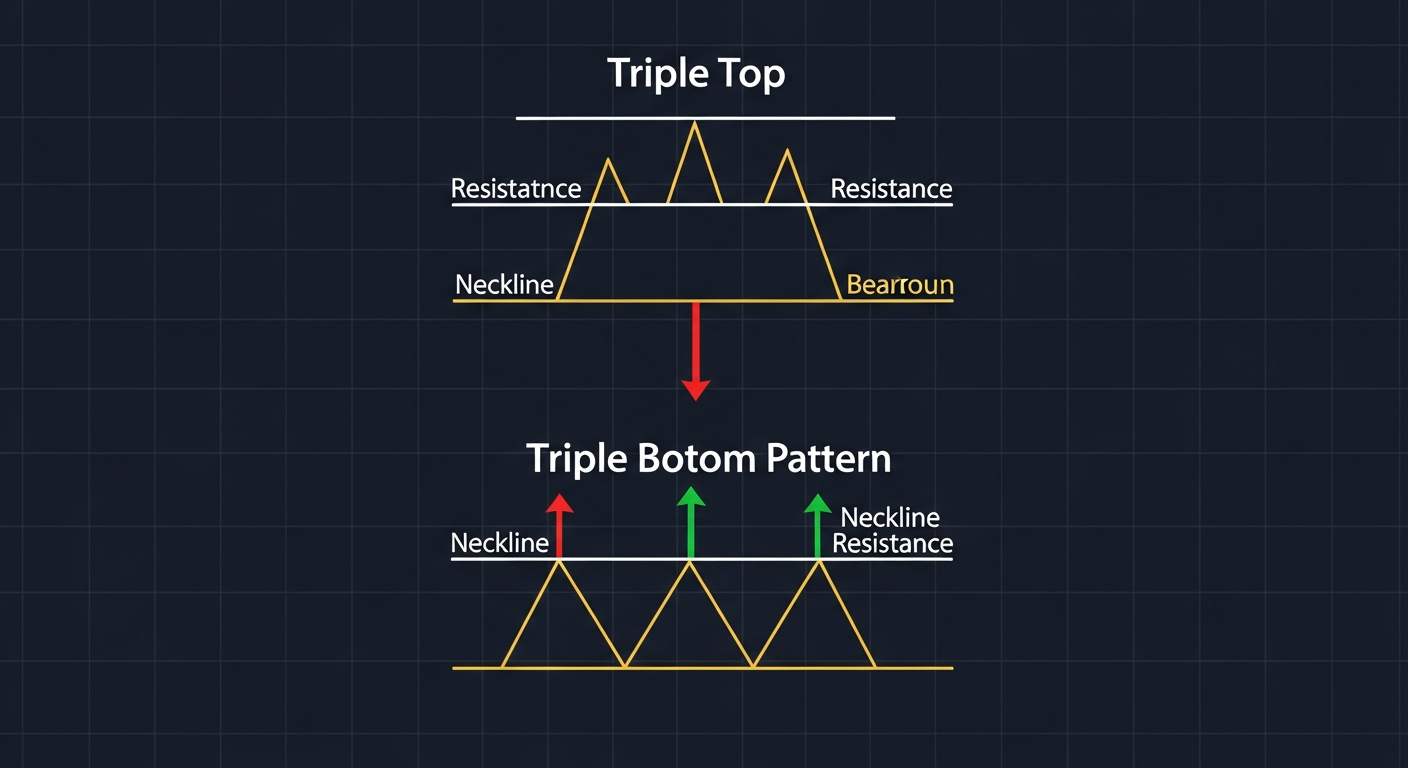
Formation
- Price rises to a resistance level three separate times
- Each peak reaches approximately the same price level
- Valleys between peaks form a "neckline" support
- Volume typically decreases on each successive peak
Psychology Behind It
- First peak: Normal profit-taking at resistance
- Second peak: Buyers try again but sellers defend
- Third peak: Buyers give up, sellers take control
- Neckline break: Remaining bulls exit, shorts pile in
Trading the Triple Top
- Identify three roughly equal peaks at resistance
- Draw the neckline across the two valleys
- Wait for a close below the neckline
- Enter short on the neckline break
- Stop loss: Above the highest peak
- Target: Distance from peaks to neckline, projected downward from the breakout
Confirmation
- Decreasing volume on each peak
- RSI bearish divergence across the three peaks
- Break below the neckline with increased volume
Triple Bottom Pattern
Formation
- Price falls to a support level three separate times
- Each trough reaches approximately the same level
- Peaks between troughs form a neckline resistance
- Volume typically increases on the third bounce
Psychology Behind It
- First bottom: Normal buying at support
- Second bottom: Sellers push again but buyers defend
- Third bottom: Sellers exhausted, buyers take control
- Neckline break: Bears cover shorts, longs pile in
Trading the Triple Bottom
- Identify three roughly equal troughs at support
- Draw the neckline across the two peaks between them
- Wait for a close above the neckline
- Enter long on the neckline break
- Stop loss: Below the lowest trough
- Target: Distance from troughs to neckline projected upward
Triple vs Double Patterns
Why Triple is Stronger
- Three tests confirm the level more definitively
- More time for accumulation/distribution to complete
- Higher probability of follow-through after breakout
- Usually produces larger measured moves
When Double Becomes Triple
- If a double top/bottom fails to break the neckline
- Price returns to test the level a third time
- Wait for the third test before re-entering
Common Mistakes
- Entering before the neckline breaks
- Peaks/troughs do not need to be exactly equal (allow 1-3% tolerance)
- Ignoring volume patterns
- Setting stops too tight (inside the pattern)
- Not accounting for false breakouts - wait for a candle close
Combining with Other Tools
- Fibonacci: Check if the neckline aligns with a key Fibonacci level
- Moving averages: The 200 SMA near the neckline strengthens the signal
- RSI: Triple divergence across all three peaks/troughs is very powerful
Key Takeaways
- Three tests of a level creates a very reliable reversal signal
- Volume should decrease on each successive test
- Always wait for the neckline break before entering
- Measured move target = distance from extreme to neckline
- Triple patterns take longer to form but have higher success rates
Lesson Discussion