Elliott Wave Trading
The Elliott Wave principle reveals the natural rhythm of crowd psychology in financial markets.
What is Elliott Wave Theory?
Developed by Ralph Nelson Elliott in the 1930s, this theory states that markets move in repetitive wave patterns driven by collective investor psychology.
The Five Wave Pattern
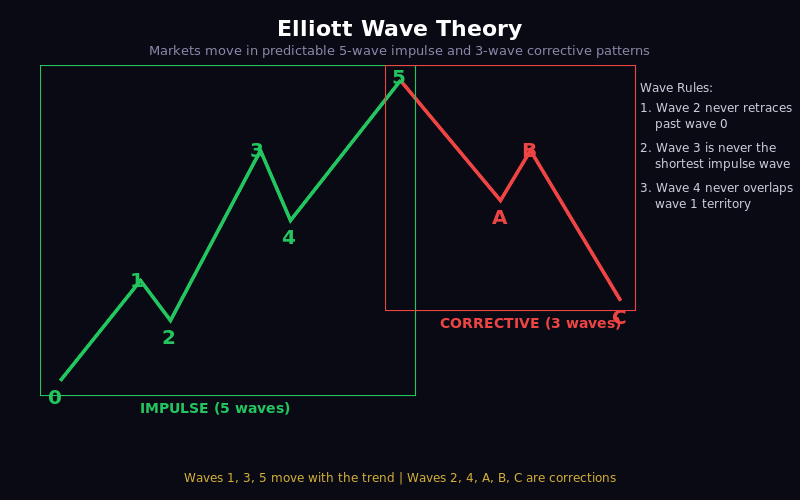
Impulse waves consist of five sub-waves:
Wave 1: The Beginning
- Initial move in new direction
- Often subtle and overlooked
- Smart money accumulating
- Low volume typically
Wave 2: The Pullback
- Retraces Wave 1 (typically 50-61.8%)
- Never retraces beyond start of Wave 1
- Doubt returns, bears confident
- Sets up the buying opportunity
Wave 3: The Power Move
- Longest and strongest wave
- Never the shortest of waves 1, 3, 5
- High volume and momentum
- News turns positive, public joins
- Often extends 1.618x Wave 1
Wave 4: The Consolidation
- Shallow correction
- Never overlaps Wave 1 territory
- Often a sideways triangle
- Retraces 23.6-38.2% of Wave 3
Wave 5: The Finale
- Final push in trend direction
- Often on diverging momentum
- Public fully invested/committed
- Sets up the major reversal
Corrective Waves

After five impulse waves, three corrective waves follow (A-B-C):
Wave A
- Initial counter-trend move
- Often mistaken for a pullback
- Smart money begins exiting
Wave B
- Counter-move that traps traders
- Often reaches near Wave 5 high
- The "bull trap" or "bear trap"
Wave C
- Final corrective move
- Usually equals Wave A in length
- Completes the correction
Wave Rules (Never Broken)
- Wave 2 never retraces more than 100% of Wave 1
- Wave 3 is never the shortest impulse wave
- Wave 4 never enters Wave 1 price territory
Wave Guidelines (Usually True)
- Wave 2 retraces 50-61.8% of Wave 1
- Wave 3 extends 1.618x Wave 1
- Wave 4 retraces 23.6-38.2% of Wave 3
- Wave 5 equals Wave 1 or extends 0.618x Wave 1
- Alternation: if Wave 2 is sharp, Wave 4 is flat
Trading with Elliott Waves
Best Entry Points
- End of Wave 2 (catching Wave 3)
- End of Wave 4 (catching Wave 5)
- End of Wave C (catching new impulse)
Using Fibonacci with Elliott
- Wave retracements align with Fibonacci levels
- Extensions predict wave targets
- Confluence of wave counts + Fibonacci = high probability
Practical Tips
- Start with higher timeframes (weekly/daily)
- Combine with other analysis for confirmation
- Wave counting takes practice - start simple
- Focus on the clearest wave patterns
- Accept that counts can be wrong - use stops
Lesson Discussion