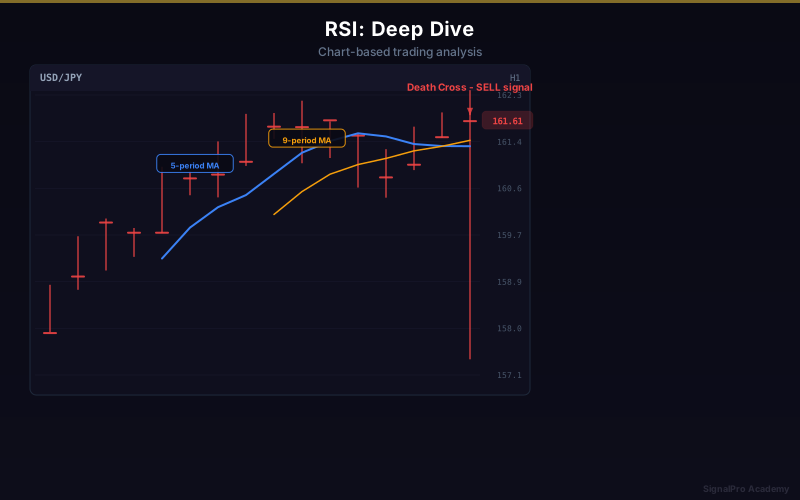
RSI: Complete Indicator Deep Dive
What RSI Measures
RSI is a technical indicator that helps traders quantify a specific aspect of price action. Understanding what it actually measures — not just what color the line is — is essential.
How It's Calculated
The calculation involves price, time and a smoothing factor. While most platforms compute it automatically, understanding the formula helps you avoid misuse.
Default Settings vs Optimal Settings
- Default platform setting: as set by your platform.
- For forex traders, consider testing alternative parameters that better fit the volatility profile of the asset.
What It Reveals
- Trend strength — when the indicator persists in one direction.
- Momentum shifts — when the indicator changes direction or crosses zero.
- Divergences — when price and indicator move in opposite directions, signaling potential reversal.
How to Use It
- Confirmation, not prediction. RSI confirms what price is already telling you. Never trade RSI alone.
- Combine with structure. Use RSI signals at key support/resistance levels, not in the middle of nowhere.
- Look for confluence. A single RSI signal is weaker than RSI agreeing with another indicator and structure.
A+ Setup with RSI
- Higher-timeframe trend bullish.
- Pullback to key support.
- RSI bullish divergence on lower timeframe.
- Confirmation candle (engulfing or pin bar).
- Enter, stop below structure, target prior high.
Common Misuse
- Reading RSI as a binary signal. It's a probability, not a guarantee.
- Using too short a period in choppy markets — generates false signals.
- Ignoring trend context — RSI signals work best WITH the higher-timeframe trend.
Backtest Notes
Always backtest RSI settings on the specific asset and timeframe you trade. Settings that work on EUR/USD daily may fail on Vol 75 1m.
Pro Tip
Most professionals overlay RSI with a structural framework (price action + RSI) rather than using RSI as the primary signal source. The structure is the foundation, RSI is confirmation.
Indicators are lenses, not crystal balls. Use them to clarify, never to predict.
Lesson Discussion