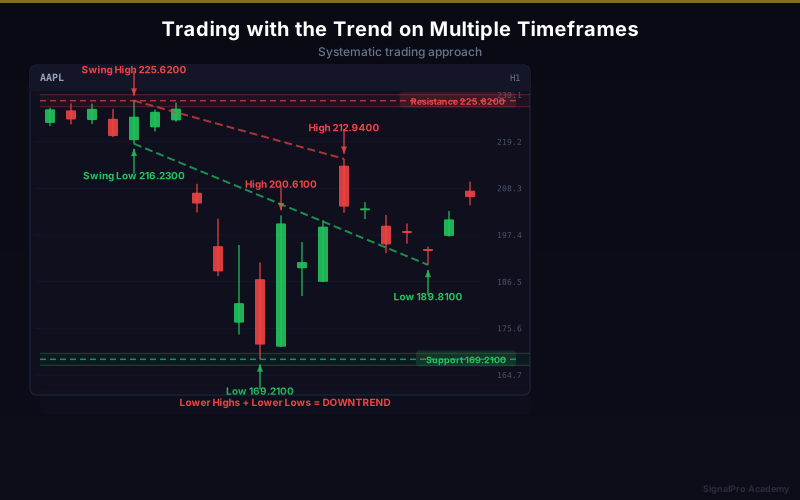
Trading with the Trend on Multiple Timeframes
Trading in the direction of the higher timeframe trend dramatically increases your probability of success.
The Multi-Timeframe Framework
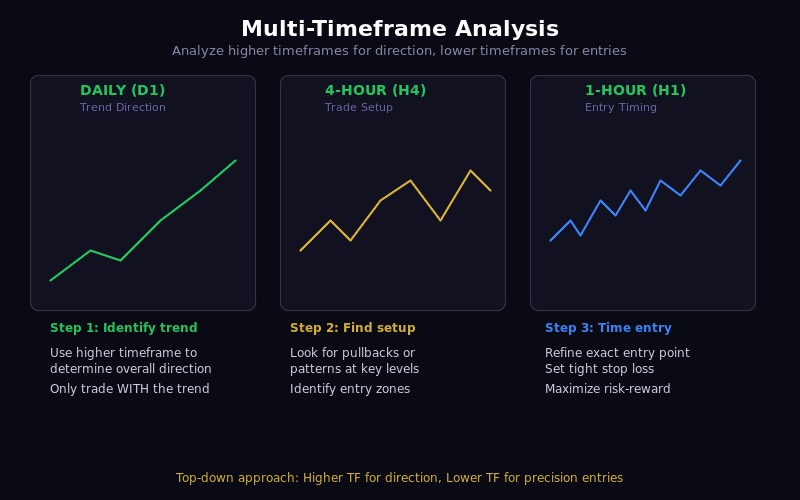
Higher Timeframe (Direction)
- Determines your trading bias (buy or sell only)
- Weekly or Daily chart
- Identifies the primary trend
- Where institutional money flows
Middle Timeframe (Setup)
- Where you find your trading setup
- 4H or 1H chart
- Identifies patterns and levels
- Where your strategy rules apply
Lower Timeframe (Entry)
- Where you time your exact entry
- 15M or 5M chart
- Refines entry and stop placement
- Where you find the best risk-to-reward
Step-by-Step Process
Step 1: Determine Direction
- Open your higher timeframe chart
- Is the trend up, down, or sideways?
- If up: only look for buy setups
- If down: only look for sell setups
- If sideways: wait or trade the range
Step 2: Find the Setup
- Switch to your middle timeframe
- Look for pullbacks to key levels
- Identify your pattern or signal
- Mark entry zone and invalidation
Step 3: Time the Entry
- Drop to your lower timeframe
- Wait for a reversal signal (candle pattern, structure shift)
- Enter with a tight stop
- This gives optimal risk-to-reward
Common Timeframe Combinations
For Swing Traders
- Higher: Weekly
- Middle: Daily
- Lower: 4H
For Day Traders
- Higher: Daily
- Middle: 1H
- Lower: 15M or 5M
For Scalpers
- Higher: 1H
- Middle: 15M
- Lower: 1M or 5M
The Power of Alignment
All Timeframes Bullish
- Highest probability buy setups
- Enter with confidence
- Use larger position sizes
- Expect extended moves
Mixed Signals
- Higher TF bullish, middle TF pulling back
- This IS a buying opportunity
- The pullback in the middle TF is your setup
- Enter on the lower TF when it turns bullish
Conflicting Trends
- Higher TF bearish, lower TF bullish
- AVOID this trade
- Lower TF is fighting the bigger trend
- Wait for alignment
Common Mistakes
- Trading against the higher timeframe trend
- Using too many timeframes (analysis paralysis)
- Not waiting for all timeframes to align
- Entering on the higher timeframe (too wide stops)
- Ignoring the lower timeframe (poor timing)
Key Takeaways
- Higher timeframe determines direction
- Middle timeframe provides the setup
- Lower timeframe gives you the entry
- Three timeframes is all you need
- Only trade when at least 2 of 3 are aligned
Lesson Discussion