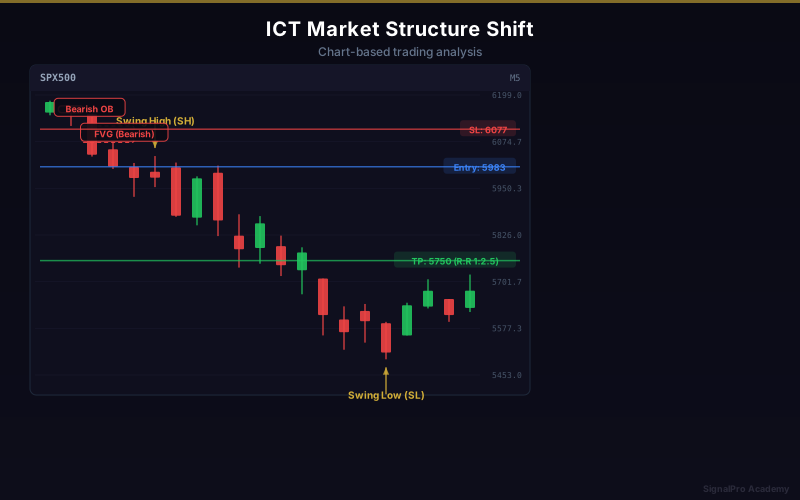
ICT Market Structure Shift
Market Structure Shift (MSS) is a core ICT concept that identifies when institutions change market direction.
What is a Market Structure Shift?
A Market Structure Shift occurs when price breaks a significant swing point, indicating a change from bullish to bearish structure or vice versa.
Bullish Structure
- Higher highs (HH) and higher lows (HL)
- Each swing low is higher than the previous
- Buyers are in control
Bearish Structure
- Lower highs (LH) and lower lows (LL)
- Each swing high is lower than the previous
- Sellers are in control
Break of Structure (BOS)
A continuation signal:
- In uptrend: Price breaks above a previous swing high
- In downtrend: Price breaks below a previous swing low
- Confirms the current trend direction
Change of Character (CHoCH)
A reversal signal:
- In uptrend: Price breaks below a previous swing low (HL broken)
- In downtrend: Price breaks above a previous swing high (LH broken)
- First sign that the trend may be changing
Bullish CHoCH
- Market is in a downtrend (LL, LH pattern)
- Price fails to make a new lower low
- Price breaks above the most recent lower high
- Structure shifts from bearish to bullish
Bearish CHoCH
- Market is in an uptrend (HH, HL pattern)
- Price fails to make a new higher high
- Price breaks below the most recent higher low
- Structure shifts from bullish to bearish
Trading the Market Structure Shift
Step-by-Step Process
- Identify Current Structure
- Mark recent swing highs and lows
- Determine if structure is bullish or bearish
- Watch for CHoCH
- Wait for a swing point to be broken
- This is your early warning signal
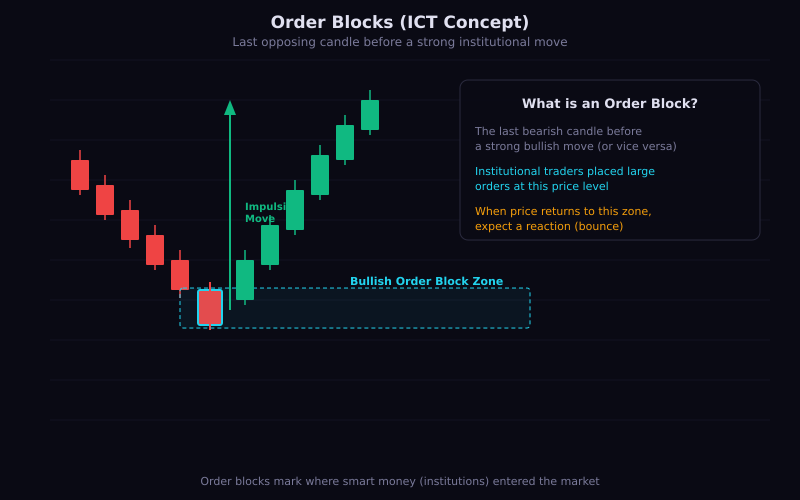
- Find the Order Block
- After CHoCH, identify the last opposing candle
- This is your entry zone (the order block)
- Wait for Retest
- Price often returns to test the order block
- This is your high-probability entry
- Enter with Confluence
- Order block + Fair value gap = best entries
- Use lower timeframe for precise entry
Combining with Other ICT Concepts
MSS + Order Blocks
- After MSS, the order block is the last candle before the structure break
- Enter on retest of this order block
- Very high probability setup
MSS + Fair Value Gaps
- FVGs created during the MSS move are powerful
- Price often returns to fill these gaps
- Enter at the FVG within the order block
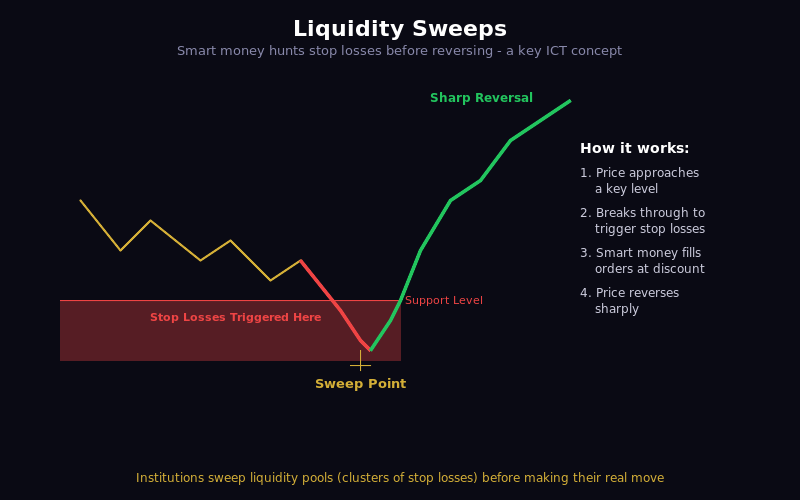
MSS + Liquidity Sweep
- Often a liquidity sweep triggers the MSS
- Watch for equal highs/lows being swept
- The sweep + MSS combo is the strongest setup
Timeframe Selection
Higher Timeframe (Daily/4H)
- Identify the major market structure
- Determine overall bias
- Look for MSS at key levels
Lower Timeframe (1H/15M)
- Refine entry after HTF MSS
- Find precise order blocks
- Time your entry to the candle
Risk Management for MSS Trades
- Stop loss: Beyond the swing point that created the MSS
- Target 1: Next significant swing point
- Target 2: Equal highs/lows that need to be swept
- Risk-to-reward: Minimum 1:3 for MSS trades
Key Takeaways
- MSS is the institutional footprint of trend changes
- CHoCH is your early warning signal
- Always combine with order blocks for entries
- Higher timeframe MSS is more significant
- Patience is crucial - wait for the retest
Lesson Discussion