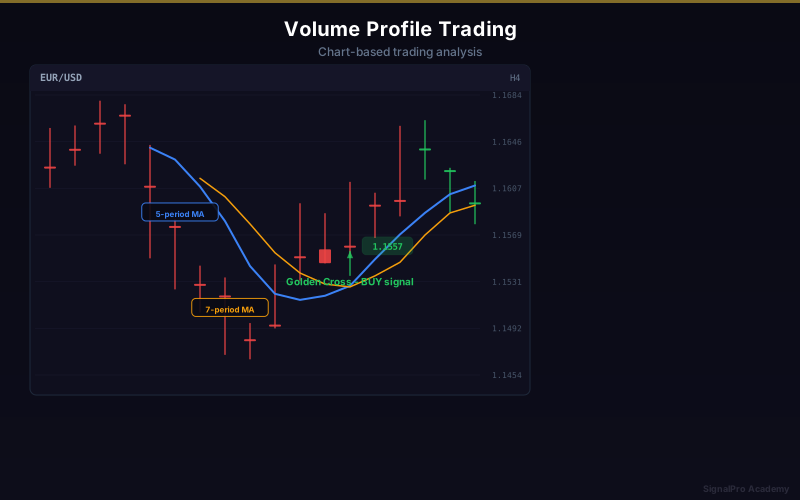
Volume Profile Trading
Volume Profile reveals where the most trading activity has occurred, showing you the true supply and demand levels.
What is Volume Profile?
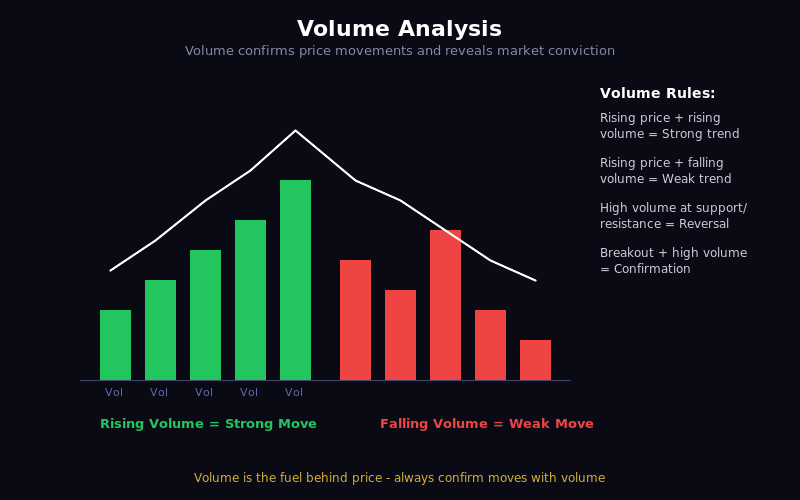
Unlike traditional volume bars at the bottom of a chart, Volume Profile displays volume as a horizontal histogram on the price axis. This shows exactly at which prices the most trading occurred.
Key Volume Profile Concepts
Point of Control (POC)
- The price level with the highest traded volume
- Acts as a magnet for price
- Major support/resistance level
- Price tends to return to POC
Value Area
- Contains approximately 70% of all volume
- Value Area High (VAH): Upper boundary
- Value Area Low (VAL): Lower boundary
- Represents fair price range
High Volume Nodes (HVN)
- Price levels with heavy trading
- Act as support/resistance
- Price often consolidates at HVNs
- Institutional interest zones
Low Volume Nodes (LVN)
- Price levels with minimal trading
- Price moves quickly through these
- Can act as breakout triggers
- Rejection zones
Types of Volume Profile
Session Volume Profile
- Shows volume for a single trading session
- Good for day trading
- Identifies intraday value areas
Fixed Range Volume Profile
- Applied to any custom time range
- Useful for swing trading
- Analyze specific price movements
Visible Range Volume Profile
- Shows volume for visible chart area
- Adapts as you scroll
- Quick reference for current context
Trading Strategies
Value Area Trading
- Price opens within value area: Trade toward POC
- Price opens above value area: Watch VAH as support
- Price opens below value area: Watch VAL as resistance
- Breakout from value area: Trend continuation
POC Bounce Strategy
- When price pulls back to POC, look for reversal
- High confluence when POC aligns with other support/resistance
- Strong when POC is well-developed (high volume)
Low Volume Node Breakout
- Price accelerates through LVNs
- Trade breakouts at LVN boundaries
- Quick moves with minimal resistance
Combining Volume Profile
- With Support/Resistance: HVNs confirm key levels
- With Moving Averages: POC + MA confluence = strong level
- With Fibonacci: Volume at Fibonacci levels = high probability
- With Order Flow: Institutional accumulation visible
Practical Tips
- Use daily/weekly profiles for swing trading
- Use session profiles for day trading
- Focus on POC and value area boundaries
- LVNs are your breakout opportunities
- The strongest levels have confluent signals
Lesson Discussion