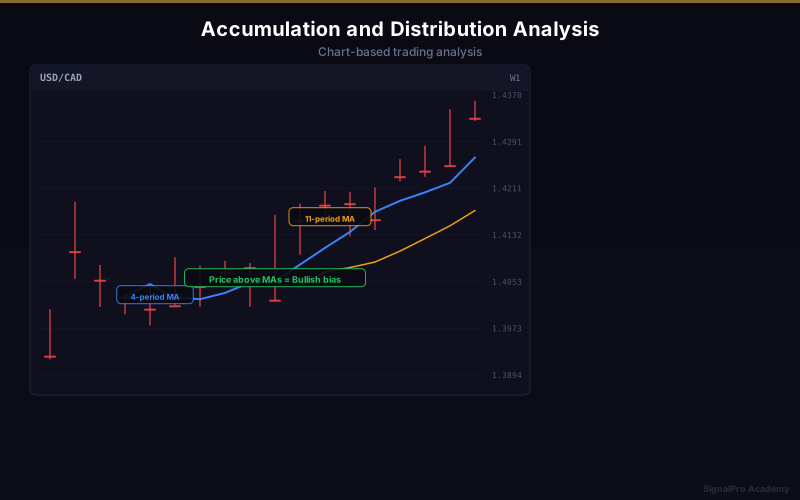
Accumulation and Distribution Analysis
Accumulation/Distribution indicators reveal whether smart money is quietly buying (accumulating) or selling (distributing), often BEFORE price reflects the move.
Understanding Money Flow
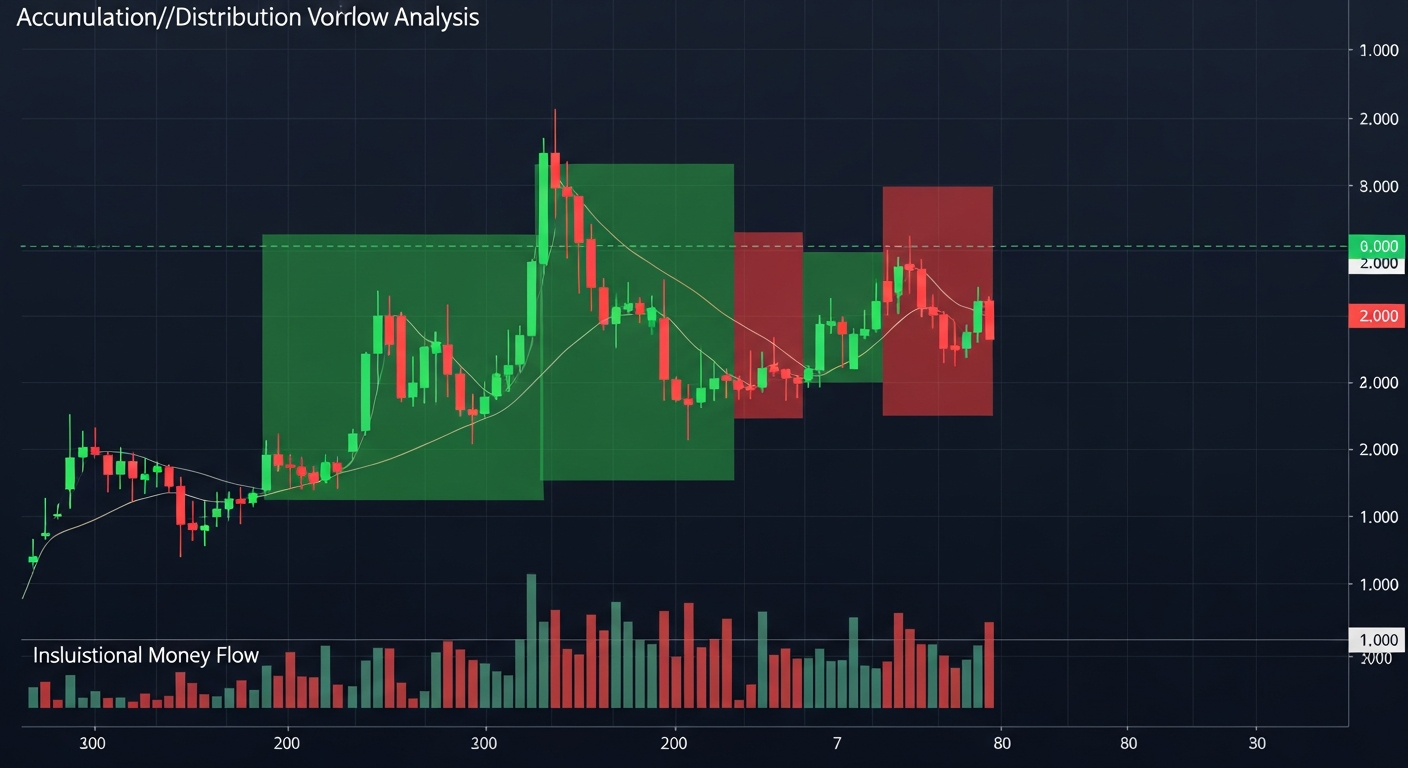
Accumulation Phase
- Large institutions buying over time
- Cannot buy all at once (would move price too much)
- Price stays flat or slightly down while buying occurs
- Volume increases on minor dips (hidden buying)
- Eventually supply is exhausted and price surges up
Distribution Phase
- Large institutions selling their positions over time
- Price stays flat or slightly up while selling occurs
- Volume increases on minor rallies (hidden selling)
- Eventually demand is exhausted and price crashes down
Key Indicators
Accumulation/Distribution Line (A/D Line)
- Formula considers close position within the bar range
- Close near high = accumulation (buying pressure)
- Close near low = distribution (selling pressure)
- Running total shows cumulative money flow
On-Balance Volume (OBV)
- Adds volume on up days, subtracts on down days
- Rising OBV = buying volume exceeding selling volume
- Falling OBV = selling volume exceeding buying volume
- Trend of OBV matters more than absolute value
Money Flow Index (MFI)
- Volume-weighted RSI
- Ranges from 0 to 100
- Above 80 = overbought with heavy volume
- Below 20 = oversold with heavy volume
- Better than RSI because it includes volume
Chaikin Money Flow (CMF)
- Measures money flow over a period (typically 20)
- Positive = buying pressure dominating
- Negative = selling pressure dominating
- Zero line crossovers signal shifts
Trading Signals
Bullish Divergence (Key Signal)
- Price makes lower low
- A/D line or OBV makes higher low
- Smart money is accumulating despite falling price
- Powerful reversal signal
- Enter long when price confirms with breakout
Bearish Divergence
- Price makes higher high
- A/D line or OBV makes lower high
- Smart money is distributing despite rising price
- Enter short when price confirms with breakdown
Trend Confirmation
- Price rising + A/D rising = healthy uptrend (accumulation supports)
- Price rising + A/D falling = warning, distribution occurring
- Price falling + A/D rising = bottom forming, accumulation starting
- Price falling + A/D falling = downtrend confirmed
Advanced Strategies
Volume Climax Detection
- Extremely high volume at price extreme
- Long upper shadow (rejection) on high volume
- Signals exhaustion of trend
- Smart money unloading to retail buyers (distribution)
- Or smart money buying panic sells (accumulation)
Time-Based Analysis
- Accumulation at market open = institutional positioning
- Distribution into close = institutions locking profits
- Mid-session volume spikes = news-driven or algorithmic
- End-of-week positioning = portfolio adjustments
Sector Rotation
- Money flows from one sector to another
- Track A/D across related instruments
- Money leaving bonds + entering stocks = risk-on
- Money leaving stocks + entering gold = risk-off
Practical Application
Daily Checklist
- Compare price trend to A/D line trend
- Look for divergences forming
- Check MFI for extreme readings
- Monitor OBV slope changes
- Combine with price action for entries
Key Takeaways
- Smart money accumulates before price rises and distributes before it falls
- Divergence between price and volume indicators = major signal
- OBV trend direction is more important than its value
- MFI adds volume context that RSI lacks
- Always confirm volume signals with price action
Lesson Discussion