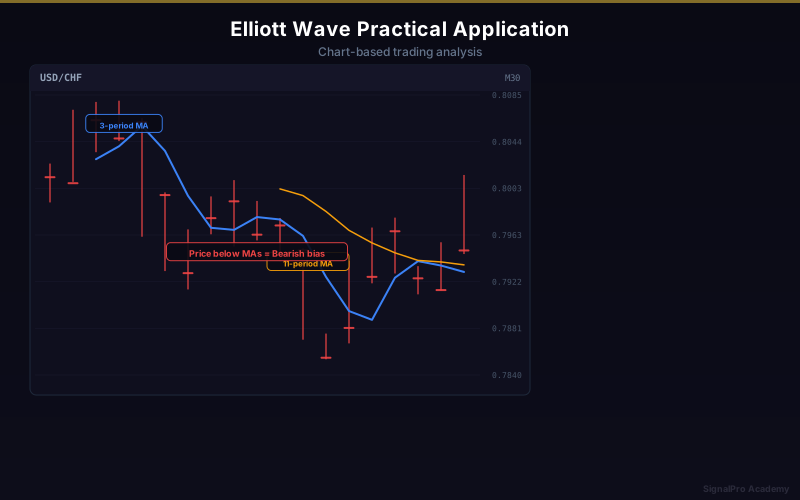
Elliott Wave Practical Application
Elliott Wave Theory provides a framework for understanding market psychology through wave patterns. This lesson focuses on practical application rather than just theory.
Core Principle
Markets move in repetitive cycles driven by mass psychology:
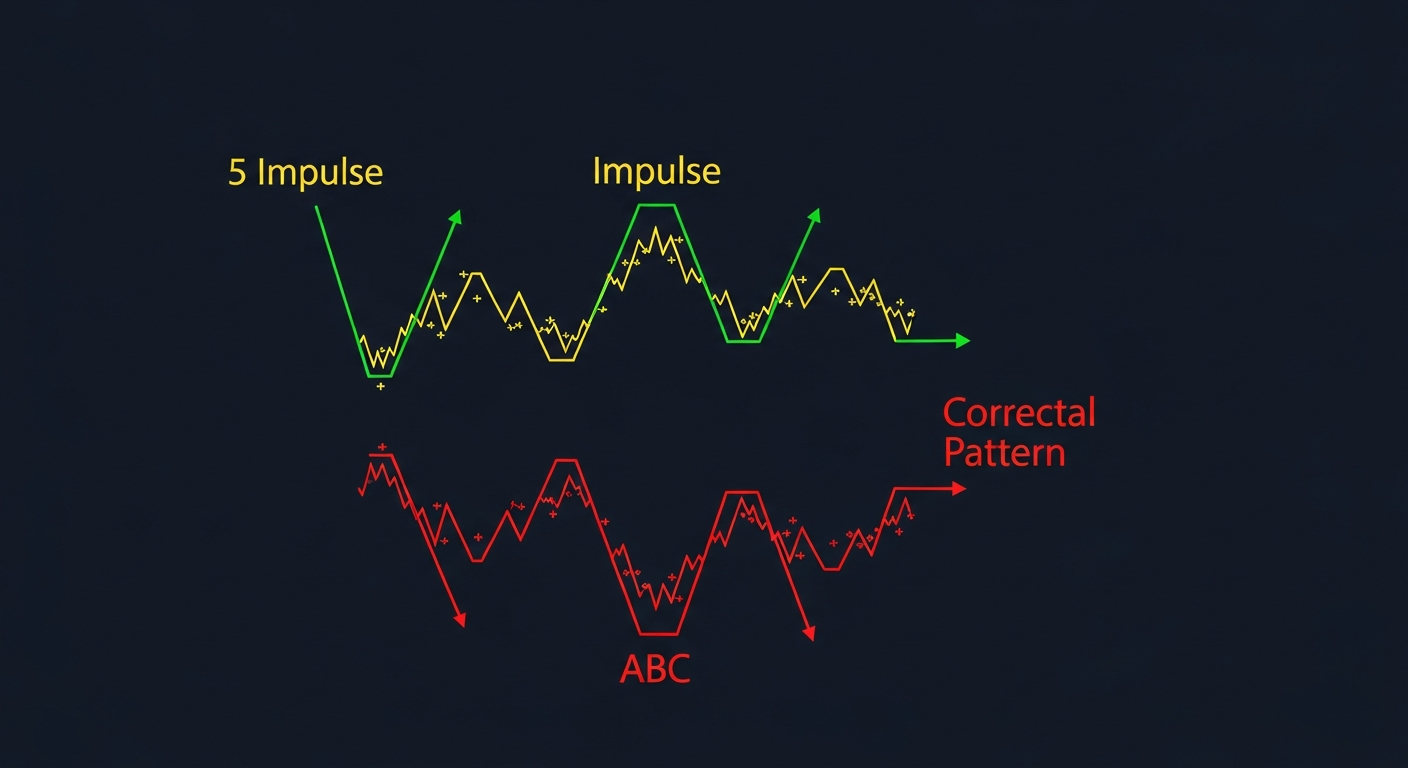
- 5-wave impulse moves in the direction of the main trend
- 3-wave corrective moves against the main trend
- These patterns are fractal: they appear on all timeframes
The Impulse Wave (5 Waves)
Wave 1
- Beginning of a new trend
- Often mistaken for a correction of the prior trend
- Usually the shortest impulse wave
- Low participation and skepticism
Wave 2
- Retraces a significant portion of Wave 1 (commonly 50-78.6%)
- Cannot retrace beyond the start of Wave 1
- Driven by doubt that a new trend has started
- Often a sharp, fast correction
Wave 3
- Usually the longest and strongest wave
- Cannot be the shortest of waves 1, 3, and 5
- Typically extends 161.8% of Wave 1
- This is where the "smart money" trades aggressively
- Volume is highest in Wave 3
Wave 4
- A shallow correction against the trend
- Cannot overlap with Wave 1 territory (golden rule)
- Typically retraces 23.6-38.2% of Wave 3
- Often more complex and time-consuming than Wave 2
- Can form triangles, flats, or zigzags
Wave 5
- Final push in the direction of the main trend
- Often driven by retail euphoria or panic
- Momentum divergence common (price makes new extreme, indicators do not)
- Sets up the reversal
The Corrective Wave (ABC)
Wave A
- First move against the completed impulse
- Often mistaken for a normal pullback
- Volume may increase
Wave B
- Counter-trend rally that tricks traders
- Can retrace up to 100% of Wave A (or more in irregular corrections)
- This is the "bull trap" in a bearish correction
Wave C
- The final corrective wave
- Usually equals Wave A in length
- Can extend to 161.8% of Wave A
- Panic selling/buying completes the correction
Three Unbreakable Rules
- Wave 2 never retraces more than 100% of Wave 1
- Wave 3 is never the shortest impulse wave
- Wave 4 never enters the price territory of Wave 1
Practical Trading Application
Trading Wave 3
- Identify a completed Wave 1 (impulse) and Wave 2 (correction)
- Wave 2 should retrace 50-78.6% of Wave 1
- Enter at the end of Wave 2 with a stop below Wave 1 start
- Target: 161.8% extension of Wave 1 from Wave 2 low
- This is the highest probability Elliott Wave trade
Trading Wave 5
- After Wave 3 completes and Wave 4 corrects
- Wave 4 typically retraces 23.6-38.2% of Wave 3
- Enter at the end of Wave 4
- Target: 61.8-100% of Wave 1 length projected from Wave 4
- Watch for divergence at the end of Wave 5
Trading the ABC Correction
- After a completed 5-wave impulse
- Wait for Wave A and B to complete
- Short at the end of Wave B
- Target: Wave C often equals Wave A in length
- Use Fibonacci expansion for precise C target
Combining with Fibonacci
Key Relationships
- Wave 2 retraces 50-78.6% of Wave 1
- Wave 3 extends 161.8-261.8% of Wave 1
- Wave 4 retraces 23.6-38.2% of Wave 3
- Wave 5 extends 61.8-100% of Wave 1
- Wave C often equals Wave A or extends 161.8%
Key Takeaways
- Wave 3 is the strongest and most profitable wave to trade
- The three rules are inviolable, use them to validate your count
- Combine wave counting with Fibonacci for precision
- Start on higher timeframes and work down for accuracy
- If the count is not obvious, step aside until it becomes clear
Lesson Discussion