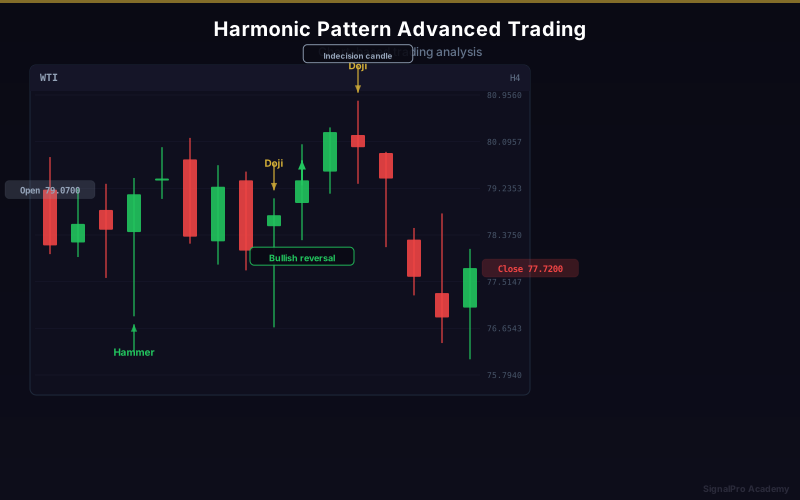
Harmonic Pattern Advanced Trading
Harmonic patterns use specific Fibonacci ratios to identify precise reversal zones. When the ratios align correctly, these patterns offer some of the best risk-to-reward entries in technical analysis.
The Foundation: XABCD Structure
All harmonic patterns follow an XABCD structure:
- X: Starting point of the pattern
- A: End of the first impulse
- B: Retracement of XA
- C: Retracement of AB (in the direction of XA)
- D: The potential reversal zone (PRZ) - your entry point
The Gartley Pattern
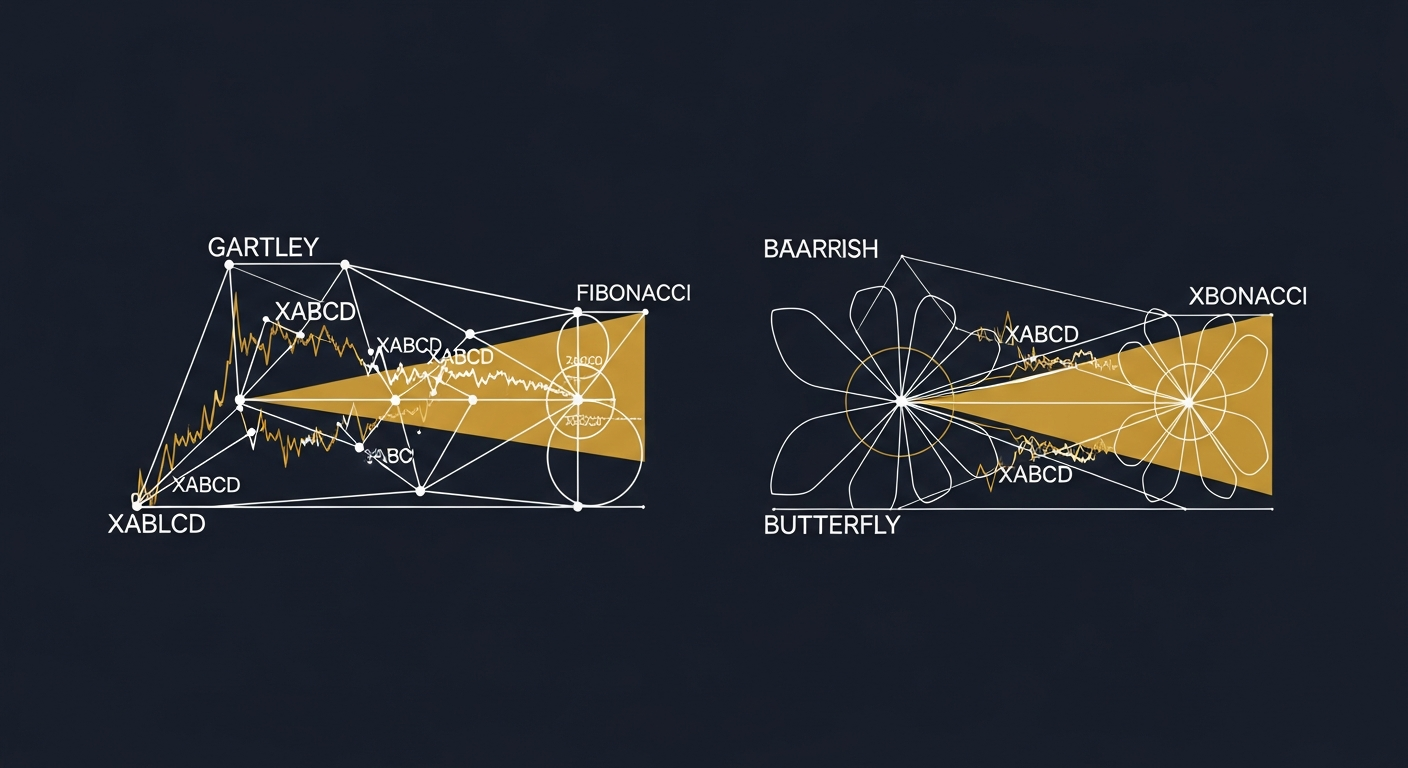
Bullish Gartley
- B retraces 61.8% of XA
- C retraces 38.2-88.6% of AB
- D completes at 78.6% of XA
- CD extends 127.2-161.8% of BC
- Entry: At D (78.6% of XA)
- Stop: Below X
- Targets: 38.2% and 61.8% of AD
Why Gartley Works
- Multiple Fibonacci confluences converge at D
- The 78.6% retracement is a "deep but not too deep" pullback
- Represents a natural market rhythm of impulse and correction
The Butterfly Pattern
Key Characteristics
- B retraces 78.6% of XA
- D extends BEYOND X (127.2-161.8% of XA)
- Appears at market extremes
- More aggressive pattern than Gartley
Trading Rules
- Enter at D (127.2% extension of XA)
- Stop: Beyond 161.8% extension
- Target: Back to A level or 38.2% of AD
- Higher reward but also higher risk than Gartley
The Bat Pattern
Key Characteristics
- B retraces 38.2-50% of XA (shallower than Gartley)
- D completes at 88.6% of XA
- Very precise reversal zone
- Allows very tight stop placement
Trading Rules
- Enter at D (88.6% of XA)
- Stop: Below X (tight stop)
- Target: 38.2% and 61.8% of AD
- Best risk-to-reward of all harmonic patterns
The Crab Pattern
Key Characteristics
- B retraces 38.2-61.8% of XA
- D extends to 161.8% of XA (deepest extension)
- Most extreme harmonic pattern
- Appears at significant turning points
Trading Rules
- Enter at D (161.8% extension of XA)
- Stop: Beyond 200% extension
- Target: Back to B level or 38.2-61.8% of AD
- Less common but very powerful when valid
Pattern Validation Rules
Must-Have Criteria
- B retracement must be within the specified range for each pattern
- D point must reach the specified Fibonacci level
- The pattern should be visually symmetrical
- Volume should decrease as the pattern forms
- A candlestick reversal at D confirms the entry
Invalidation
- Price moves beyond the stop level before reaching D
- Pattern takes too long to complete (loses relevance)
- Volume spikes against the expected direction at D
Scanning for Harmonic Patterns
Manual Method
- Identify a significant XA swing on the daily chart
- Measure the B retracement percentage
- If B is near 61.8%, look for a Gartley
- If B is near 78.6%, look for a Butterfly
- If B is near 38.2-50%, look for a Bat
- Wait for D to reach the required level
- Enter only with candlestick confirmation
Key Takeaways
- Each harmonic pattern has specific Fibonacci ratio requirements
- The Bat pattern offers the best risk-to-reward due to a tight PRZ
- The Butterfly and Crab appear at market extremes for powerful reversals
- Always validate with a reversal candle at point D
- Combine harmonic patterns with support/resistance for highest probability
Lesson Discussion